So I've finally made it to Prague where I have hung up my backpack for a couple of weeks and take advantage of the free food and ablution facilities - it feels great to be able to have more than one shower a week, although I still can't bring myself to be decadent enough to have one every day. I know Prague pretty well because since the age of four I've visited the place at least once a year either to visit my grandmother or my father who, now that he's retired, has now permanently moved back to our house in his hometown just on the outskirts of the city. So, despite Prague being such a romantic and beautiful city it had long ago lost its charm for and become a city like many others. And, like most inhabitants of Prague, in Summer I would avoid the historical, touristic centre like the plague, unwilling to have to push my way through hordes of tourists and pay through the nose for overpriced beer. Now, however, I am having to dive back in and play the tour guide as my far-flung family is converging here to celebrate my uncle's 50th wedding anniversary next week. It hasn't been anything like a chore though, partly because it has been a long time since I was last here and so I'm enjoying rediscovering the wee nooks and crannies in the old town, but also because I am now better able to put what I see in context (historically, artistically, etc.) and so can appreciate it more and truly treasure the amazing city. And because this has also been the longest that I have been away from Prague the small, almost indiscernible, daily changes have piled up and upon arriving along the motorway driving past the suburbs I was immediately struck by the flashy new office buildings and the huge amount of construction work, especially of infrastructure, going on. Things are certainly changing in Prague despite the constancy of Charles' bridge and the imposing silhouette of the castle lording over the city from the far bank of the Vltava. Part of me is somewhat sad though, wanting to halt the economic progress, remembering with fondness the years just before and after the fall of Communism when it seemed to my young eyes that the city belonged to us alone and ice-creams cost a pittance (I wasn't old enough to have focused my taste buds on the finer rewards of the local beer). Now there are more tourists than locals in the centre and Prague is no longer an exotic destination, instead it has become the stag party capital of Europe. Even our little town hasn't been able to escape the tsunami of change. Apartment blocks are springing up in this mostly rural location and people don't seem to know each other as much - it used to be that you would always bump into someone you knew on the train to and from Prague but now not a single face is familiar. Luckily I still have a few friends here and there who I will be winkling out during my stay and having a few beers with.
Sunday, July 15, 2007

Monday, July 09, 2007
Industry Past And Present
Apart from the slight differences in language there are other disparities between Czech and Slovakia. The former was always more sceptical when it came to questions of faith experiencing the Hussite wars and being the scene of the infamous defenestration of Prague (when some disgruntled Protestant nobles threw a couple of Catholic governors out of the a window in Prague castle) which started the Thirty Years' war. In fact the Czechs are the most irreligious people in Europe with 59% of the population claiming to be atheist or agnostic in the last census. Not so their eastern neighbours where churches are full, queues to confessional are long (so long, in fact, that at one church I saw a sign requesting the faithful to forgo with the usual opening formalities and to quickly recite their sins so that the overworked priest could see to everybody) and many people have discreet pictures of the pope - ex-pope - in their cars. So, whilst on my way to the picturesque medieval town of Levoča, I saw many people walking along the side of the road, either singly or in groups, old and young, some carrying crosses in front of them like standards, all converging on the little town and its church on a hill dedicated to the Virgin. Apparently it's one of the largest pilgrimages in central Europe with hundreds of thousands of people coming from Poland, Hungary, Ukraine and Austria as well as from all corners of Slovakia. Such an event would never occur in Czech where the only site of pilgrimage is the local pub and the only prayer "just one more for the road."
The Czechs were also always more industrially developed and richer than the Slovaks and so following the Velvet Divorce of 1993 when the two countries separated (instigated, incidentally, by Slovak politicians) the Slovak economy fared considerably worse. Lately, however, they have been catching up and over the past two years the Slovak economy has been the fastest growing in Europe. The main motor for this success has been the recent influx of car manufacturers eager to take advantage of the cheap, skilled workforce and close proximity to European markets. Slovakia now produces more cars per capita than any other country in the world.
Just across the border from Slovakia is the once-industrial town of Zlín. Here it wasn't cars that were produced but shoes, and Zlín will forever be intimately linked with the name Baťa. Just over a century ago Tomáš Baťa founded his shoe company. Things started relatively slowly, but after visiting America the Tomáš came back inspired by Henry Ford with new ideas about mass production and factory techniques, and things started moving along faster, getting a boost with WWI when the Austrian army placed a big order and the company never looked back. At its peak, before the outbreak of WWII the Baťa empire was the biggest manufacturer of shoes in the world with factories in four continents with a workforce numbering over 100,000, diversifying into the whole shoe-making process with farms in Argentina (for the leather) and rubber plantations in Brazil amongst others, and at the centre of it all was Zlín. The Tomáš wasn't content just to make money but there was a social vision as well, and with the wealth and power he wielded in Zlín (he became elected major in 1923 and ran the place like his own little fief) he had the wherewithall to see it through. The town became a blank slate for Tomáš's ideas of social harmony and welfare. For his workers he built affordable family houses each with its own little garden, social amenities and clubs, as well as a number of schools colleges for subjects as diverse as filmography, management, architecture and even aviation. Zlín became a planned town, the plan being Baťa's. He brought in architects from all over the world to design the town along the constructivist lines popular at the time and elevated this once-insignificant town into a major industrial centre. And since it all sprang up in such a short period the entire town is like an open-air museum of 20's and 30's architecture, and at dominating it all is the mrakodrap (skyscraper), the building that was once the HQ of Baťa and the tallest building in Czechoslovakia (though that's not saying much as it only has a rather underwhelming 16 floors). Many of Tomáš's ideas and innovations were ahead of his time, especially with regards to worker welfare, though some of them were a little more strange, such as having his office in a special, enlarged elevator so that he could get in touch with the various departments more quickly.
Unfortunately WWII put paid to all those grand plans. First the company (or at least the parts of it that were in occupied territory) were sequestered by the Nazis for their war effort and then immediately afterwards the Communists nationalised it accusing Jan Antonin Baťa (who took over from his brother Tomáš who died in an air crash) of collaborating with the Germans (despite the fact that he managed to save a large number of Jews and ordinary Czechs from prison and concentration camps). Because the company was truly international the Baťa family was able to escape to Canada and regroup the eviscerated firm which exists to this day and is moderately successful around the world. Zlín was not so fortunate, not only did it suffer the ultimate humiliation of having its name changed to Gottwaldov (after the Czech Communist leader), but as the bolshevik ideology was to rest on the laurels of those who had gone before. The factories at Zlín were left to run in the same way and with the same machines as in the pre-war years. Such stagnation didn't matter in the quota-world of the planned economy but as soon as the system collapsed and the market became exposed to competition they just couldn't cope and were shut down within a matter of years.
Nowadays Zlín is going through somewhat of a renaissance (or is at least trying to) with emphasis being put on education, through the extensive university that grew out of Baťa's colleges, and the abandoned factory buildings refurbished, spruced up and converted for different uses. Sadly, as many Czechs lament, this story is not unique and many companies that were once world class in their respective fields have fallen by the wayside or are pale imitations of their former selves: Skoda (cars), Tatra and Liaz (both truck manufacturers), Skoda (heavy industry) and Jawa (motorbikes). But when feeling nostalgic the Czechs soon remind themselves that they still have the best (and cheapest!) beer in the world, and decide to make sure that it's still the case and head off to the local pub.
The Czechs were also always more industrially developed and richer than the Slovaks and so following the Velvet Divorce of 1993 when the two countries separated (instigated, incidentally, by Slovak politicians) the Slovak economy fared considerably worse. Lately, however, they have been catching up and over the past two years the Slovak economy has been the fastest growing in Europe. The main motor for this success has been the recent influx of car manufacturers eager to take advantage of the cheap, skilled workforce and close proximity to European markets. Slovakia now produces more cars per capita than any other country in the world.
Just across the border from Slovakia is the once-industrial town of Zlín. Here it wasn't cars that were produced but shoes, and Zlín will forever be intimately linked with the name Baťa. Just over a century ago Tomáš Baťa founded his shoe company. Things started relatively slowly, but after visiting America the Tomáš came back inspired by Henry Ford with new ideas about mass production and factory techniques, and things started moving along faster, getting a boost with WWI when the Austrian army placed a big order and the company never looked back. At its peak, before the outbreak of WWII the Baťa empire was the biggest manufacturer of shoes in the world with factories in four continents with a workforce numbering over 100,000, diversifying into the whole shoe-making process with farms in Argentina (for the leather) and rubber plantations in Brazil amongst others, and at the centre of it all was Zlín. The Tomáš wasn't content just to make money but there was a social vision as well, and with the wealth and power he wielded in Zlín (he became elected major in 1923 and ran the place like his own little fief) he had the wherewithall to see it through. The town became a blank slate for Tomáš's ideas of social harmony and welfare. For his workers he built affordable family houses each with its own little garden, social amenities and clubs, as well as a number of schools colleges for subjects as diverse as filmography, management, architecture and even aviation. Zlín became a planned town, the plan being Baťa's. He brought in architects from all over the world to design the town along the constructivist lines popular at the time and elevated this once-insignificant town into a major industrial centre. And since it all sprang up in such a short period the entire town is like an open-air museum of 20's and 30's architecture, and at dominating it all is the mrakodrap (skyscraper), the building that was once the HQ of Baťa and the tallest building in Czechoslovakia (though that's not saying much as it only has a rather underwhelming 16 floors). Many of Tomáš's ideas and innovations were ahead of his time, especially with regards to worker welfare, though some of them were a little more strange, such as having his office in a special, enlarged elevator so that he could get in touch with the various departments more quickly.
Unfortunately WWII put paid to all those grand plans. First the company (or at least the parts of it that were in occupied territory) were sequestered by the Nazis for their war effort and then immediately afterwards the Communists nationalised it accusing Jan Antonin Baťa (who took over from his brother Tomáš who died in an air crash) of collaborating with the Germans (despite the fact that he managed to save a large number of Jews and ordinary Czechs from prison and concentration camps). Because the company was truly international the Baťa family was able to escape to Canada and regroup the eviscerated firm which exists to this day and is moderately successful around the world. Zlín was not so fortunate, not only did it suffer the ultimate humiliation of having its name changed to Gottwaldov (after the Czech Communist leader), but as the bolshevik ideology was to rest on the laurels of those who had gone before. The factories at Zlín were left to run in the same way and with the same machines as in the pre-war years. Such stagnation didn't matter in the quota-world of the planned economy but as soon as the system collapsed and the market became exposed to competition they just couldn't cope and were shut down within a matter of years.
Nowadays Zlín is going through somewhat of a renaissance (or is at least trying to) with emphasis being put on education, through the extensive university that grew out of Baťa's colleges, and the abandoned factory buildings refurbished, spruced up and converted for different uses. Sadly, as many Czechs lament, this story is not unique and many companies that were once world class in their respective fields have fallen by the wayside or are pale imitations of their former selves: Skoda (cars), Tatra and Liaz (both truck manufacturers), Skoda (heavy industry) and Jawa (motorbikes). But when feeling nostalgic the Czechs soon remind themselves that they still have the best (and cheapest!) beer in the world, and decide to make sure that it's still the case and head off to the local pub.
Friday, July 06, 2007
Recomprehension
It's good to be in Slovakia where the veil of incomprehension has finally been lifted and I can communicate with anybody on the street (and sometimes I do just that asking unnecessarily often for directions just because I can). Theoretically Czech and Slovak are two different languages but as far as I'm concerned Slovak is just slightly misspelt Czech and the two are so mutually intelligible that no real effort has to be made when a Czech and a Slovak converse. During Czechoslovak days the daily news on TV and the radio would be alternately broadcast in the two languages. There are, of course, a few differences mainly because of the different histories of the two countries: until the inception of Czechoslovakia in 1918 Slovakia was always a part of the Hungarian empire whereas the Czech lands (Bohemia and Moravia) were always under the influence of the Germanic Holy Roman or Austrian empires. As such one contains more Hungarian, whilst the other more German, loanwords. I, however, like Slovakian which has a more sing-song quality to it than Czech and people often end phrases with a jolly hej?
The main metropolis in the east of the country is Košice, which used to be the second-largest town in Hungary until Hungary was carved up after WWI (any historical museum in Hungary will lament, at least once, that it lost two thirds of its territory at the Treaty of Triannon) and you can still find a fair number of Hungarian Slovaks in this part of the country. Hungary's biggest national hero, Ferenc Rakoczi, was also born and is buried here and his house-museum is a little pilgrimage site for visiting Hungarians as can be attested by the statue of the venerated man which is bedecked in the white, green and red colours of their national flag. For such a historic city the old core is suitably ornate and grand, however the rest of the city is a bolshevik blot on the landscape. The Communists, wanting to industrialise this mostly agrarian region decided to set up a gigantic steel-mill in the town, despite it not being particularly close to any raw materials, or markets for that matter. So the city's population tripled in a very short space of time leading to a labyrinth of boxy, concrete apartment blocks sprouting up around the city. A pity as the centre deserves better, but such were the ineffable ways of Communist planning.

Tuesday, July 03, 2007
Bor-ing
Finally the plains of the puszta have given way to some hills in the north of the country. In my week in Hungary so far I have learnt the words jo (good), köszönöm (thank you) and igen (yes). Not very good going by any standards. Though yesterday I learnt another word: bor (wine). Now I'm not much of an alcoholic (and certainly not on this trip as I can't afford it) and even less of an oenologue, but a visit to eastern Hungary wouldn't be complete without taking in the famous Tokaj region which produces some of the best sweet white wines in the world. Arriving in the quaint little town of Tokaj the visitor is bor-ed from all sides as every other building seems to be a wine cellar offering wine tastings for the visiting gourmet. Although its reputation became somewhat overshadowed by French and German wines during the Communist years, in the 17th to 19th centuries Tokaj was the wine for discerning nobles. The Russian tsars kept a permanent garrison in town to ensure the safety of their supplies, and none other than Louis XIV the Sun King, declared the sweet Aszu wine to be "Vinum Regum, Rex Vinorum" (Wine of kings, King of wines), no small accolade giving that he had some pretty decent plonk on his own doorstep. Plus this is the very first place, or so it is claimed, to have a specially protected name/trademark dating all the way back to 1730.
Well, being the dedicated traveller and discoverer of strange, exotic customs I decided to sacrifice myself to the advancement of human knowledge and signed myself up for a tasting (as it were). At a normal such tasting you are presented with a half-dozen different wines and some bland buns and water to cleanse your palate between wines. For the more dedicated there is a small sheet with the various vital statistics of each brew (such as alcohol and sugar content, acidity as well as the price, should you wish to make a purchase afterwards and carry on your tasting in private) and a jar to pour out unwanted wine so that one doesn't become too drunk. "Excuse me?" I asked my hostess. "Some people do several tastings in a day and don't want to get drunk," she explained. "That's OK," I assured her, "I won't be wasting any precious alcohol." (Both of us were probably thinking the same thing: crazy foreigners!) Well, I certainly got pleasantly tipsy and learnt a bit about wine making, though personally I couldn't tell the difference between the wine at 30 euros and the one for only 10. A good thing for me that I'm not a gourmet! I did have fun trying to find the most expensive bottle on sale (ever the child) and unearthed a half litre bottle of Eszencia for over 100 euros, and I was assured that there were better years if I asked around.
Even closer to the Slovak border there are the beginnings of smallish mountains, well, hills really. They're not much to look at but they hide a magical world of caves, packed with stalagmites and tites (remember, mites go up and tites go down) underneath. Some of them even straddle the border and so you can legally cross an international border underground, though you need to book in advance for that so of course that was never going to happen. Instead I just tagged along on an ordinary tour, though it was cool nonetheless with some exquisite rock formations. Very cool, now if only they can teach the guides some English...
Well, being the dedicated traveller and discoverer of strange, exotic customs I decided to sacrifice myself to the advancement of human knowledge and signed myself up for a tasting (as it were). At a normal such tasting you are presented with a half-dozen different wines and some bland buns and water to cleanse your palate between wines. For the more dedicated there is a small sheet with the various vital statistics of each brew (such as alcohol and sugar content, acidity as well as the price, should you wish to make a purchase afterwards and carry on your tasting in private) and a jar to pour out unwanted wine so that one doesn't become too drunk. "Excuse me?" I asked my hostess. "Some people do several tastings in a day and don't want to get drunk," she explained. "That's OK," I assured her, "I won't be wasting any precious alcohol." (Both of us were probably thinking the same thing: crazy foreigners!) Well, I certainly got pleasantly tipsy and learnt a bit about wine making, though personally I couldn't tell the difference between the wine at 30 euros and the one for only 10. A good thing for me that I'm not a gourmet! I did have fun trying to find the most expensive bottle on sale (ever the child) and unearthed a half litre bottle of Eszencia for over 100 euros, and I was assured that there were better years if I asked around.
Even closer to the Slovak border there are the beginnings of smallish mountains, well, hills really. They're not much to look at but they hide a magical world of caves, packed with stalagmites and tites (remember, mites go up and tites go down) underneath. Some of them even straddle the border and so you can legally cross an international border underground, though you need to book in advance for that so of course that was never going to happen. Instead I just tagged along on an ordinary tour, though it was cool nonetheless with some exquisite rock formations. Very cool, now if only they can teach the guides some English...
Friday, June 29, 2007
Flat
From Serbia I headed northwards into eastern Hungary. The towns, such as Szeged and Debrecen, are clean and orderly, the centres displaying the wealth and power of a bygone era, from the age of empire. And though everything is neat and tidy (they even have extensive cycle lane networks, something we haven't managed to set up in Britain) it lacks the depaysment I've grown accustomed to and therefore marks the beginning of my return home to 'civilisation'. Here supermarkets are stacked with the exact same products and brands as in the rest of western Europe; cars ignore the fact that they are bigger, tougher and less mortal than mere pedestrians and obey traffic rules; and wide, uncluttered pavements and pedestrian malls make for effortless, carefree strolling. In a strange way I'm missing Chinese supermarkets with their aisles of freezers filled with innumerable types of dumplings and where you can buy live terrapins (though not as pets); I recall with fondness having to take my life into my own hands every time I crossed the road in Cairo; my taste buds still tingle at the thought of streetfood from around the world - Mexican tamales, Bolivian empanadas and Laotian sticky rice with something-grilled-ona-stick (best not to ask what it was); and I like to reminisce about the constant obstacle course that constitutes walking in an Indian town, having to continually look out for potholes, open sewers, cowpats or fresh piles of human excrement. (On second thoughts scratch that last one.) Hungary does at least have one exotic thing going for it: its language. Totally unlike any of its neighbours and only distantly related to Finnish you can forget even trying to understand it. Plus, what I find quite astonishing, very few ordinary Hungarians seem to be able to speak another language, be it English, Russian or German (the latter being the most common). But luckily for me this ought to be the last country where language is a barrier and I can start being a bit more lazy, at least on that front.
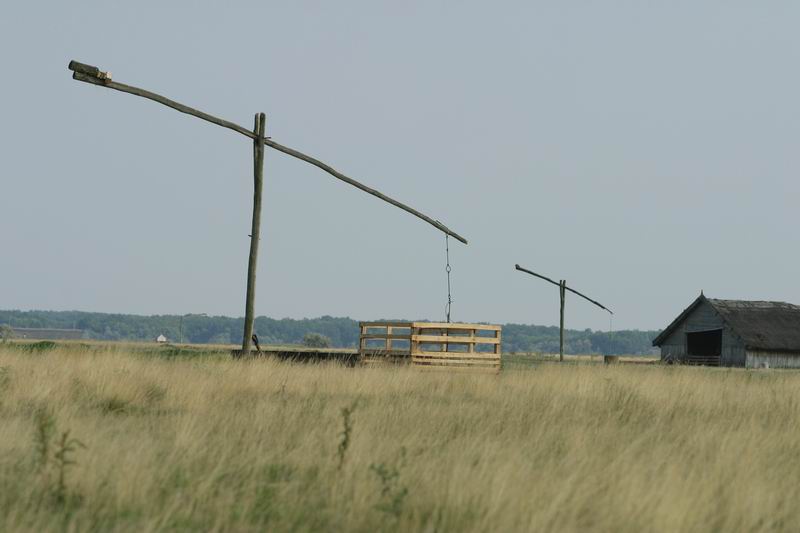
In terms of landscape the east of the country s easy to describe: flat. Over half the entire country is taken up by the Great Hungarian Plain, also known as the puszta. Historically the area was mainly boggy marshland, but after the Tisza river, which flows through the plain, was controlled in the 19th century much of the land became available for agriculture and now huge fields of wheat and corn stretch to the horizons on either side as you drive through. The uniformity is broken by the odd farmhouse - low, thatched and very long - and the unique wells that have become a symbol of the region. Some areas of original marshland also remain, which have become havens for waterbirds, and where people still herd the characteristic Hungarian longhorn cattle. Although it might sound rather boring compared with the dramatic allure of the mountains, there is something calm and immense about the puszta, especially with the low cumulus clouds that emphasize the sense of distance by forming a fluffy 'lid'. I had a great day ccycling around the little field tracks amongst the old farms and ponds, and it wasn't until after my late lunch, when I sat back on my bike, that I realised how big the place is and how far I had ridden, a reminder that I feel even now as I sit here typing this post.
In terms of landscape the east of the country s easy to describe: flat. Over half the entire country is taken up by the Great Hungarian Plain, also known as the puszta. Historically the area was mainly boggy marshland, but after the Tisza river, which flows through the plain, was controlled in the 19th century much of the land became available for agriculture and now huge fields of wheat and corn stretch to the horizons on either side as you drive through. The uniformity is broken by the odd farmhouse - low, thatched and very long - and the unique wells that have become a symbol of the region. Some areas of original marshland also remain, which have become havens for waterbirds, and where people still herd the characteristic Hungarian longhorn cattle. Although it might sound rather boring compared with the dramatic allure of the mountains, there is something calm and immense about the puszta, especially with the low cumulus clouds that emphasize the sense of distance by forming a fluffy 'lid'. I had a great day ccycling around the little field tracks amongst the old farms and ponds, and it wasn't until after my late lunch, when I sat back on my bike, that I realised how big the place is and how far I had ridden, a reminder that I feel even now as I sit here typing this post.
Monday, June 25, 2007
Dinner In Vojvodina
The northern third of Serbia is taken up by the region of Vojvodina which enjoys the status of an autonomous province (just like Kosovo until it became a de facto state under UN control). Vojvodina, on the other hand, has never had secessionist ambitions, possibly because the flat land would make a guerrilla war very difficult, but more likely because the place is itself a mini melting pot of many different ethnic groups (26) and 6 official languages - Serb, Hungarian, Slovak, Roma, Croat and Rusyn. So, depending on the ethnic make-up of a particular town signs will generally be in two, or perhaps three, languages.
During the 1999 NATO bombing of Serbia the region was heavily targeted and many of the bridges that cross the Danube linking Vojvodina to Serbia proper were destroyed (three alone in Novi Sad, the capital). Since it's so far removed from Kosovo and of little strategic importance (it was the equivalent of bombing Plymouth to help protect the Scots in their bid for independence) that some analysts suggested that NATO wanted to push Vojvodina into separating from Serbia as well (still others believed the main reason was that the Americans had too many old bombs lying around and wanted an amusing way of getting rid of them). That was never going to happen as the people are far more interested in parties than politics. During the day in their spare time most Vojvodians(?) are down by the beach not caring in the least that they are landlocked: they have the Danube, they have sand and they have parasols so they're bloody well going to the beach. And in the evenings there always seems to be some sort of free live music either in town or by the river, and lubricating this party machine, like the oil of mirth, is copious amounts of beer.
For those with a penchant for something a little more serious Vojvodina has its share of history and spirituality. When the Turks captured Serbia and pushed their borders up to the Sava and Danube many Serbs fled north setting up a new patriarchate and many monasteries in the area around Fruška Gora leading to the low hill to become known as the Holy Mountain. Today it is a national park and there are many hiking trails that wind through the forests linking the still-functioning monasteries. Going further back during the last days of the Roman Empire and the Tetrarchy, the city of Sirmium (today's Sremska Mitrovica) became one of the capitals of the empire. But before any history buffs start packing their bags and making travel plans there is woefully little to be seen from the time (even the standard low walls look frightfully forlorn), though the town has a nice art nouveau centre.
During the 1999 NATO bombing of Serbia the region was heavily targeted and many of the bridges that cross the Danube linking Vojvodina to Serbia proper were destroyed (three alone in Novi Sad, the capital). Since it's so far removed from Kosovo and of little strategic importance (it was the equivalent of bombing Plymouth to help protect the Scots in their bid for independence) that some analysts suggested that NATO wanted to push Vojvodina into separating from Serbia as well (still others believed the main reason was that the Americans had too many old bombs lying around and wanted an amusing way of getting rid of them). That was never going to happen as the people are far more interested in parties than politics. During the day in their spare time most Vojvodians(?) are down by the beach not caring in the least that they are landlocked: they have the Danube, they have sand and they have parasols so they're bloody well going to the beach. And in the evenings there always seems to be some sort of free live music either in town or by the river, and lubricating this party machine, like the oil of mirth, is copious amounts of beer.
For those with a penchant for something a little more serious Vojvodina has its share of history and spirituality. When the Turks captured Serbia and pushed their borders up to the Sava and Danube many Serbs fled north setting up a new patriarchate and many monasteries in the area around Fruška Gora leading to the low hill to become known as the Holy Mountain. Today it is a national park and there are many hiking trails that wind through the forests linking the still-functioning monasteries. Going further back during the last days of the Roman Empire and the Tetrarchy, the city of Sirmium (today's Sremska Mitrovica) became one of the capitals of the empire. But before any history buffs start packing their bags and making travel plans there is woefully little to be seen from the time (even the standard low walls look frightfully forlorn), though the town has a nice art nouveau centre.
Thursday, June 21, 2007
Bucolic Belgrade
As you travel north through Serbia the mountains gradually become smaller until you reach the Danube and the gently rolling hills of the Pannonian Plain. The characteristic sharp Ottoman minarets also become more scarce giving way to curvy orthodox churches. The forested countryside is dotted with small towns and villages merging unobtrusively into the landscape, each house possessing a sizeable garden with carefully tended vegetable plots and fruit trees. Like other Communist countries in which political expression and entrepreneurship were stifled (though in Yugoslavia less than in other places) the main outlet for peoples' energies were their homes and gardens which, despite modest means, were continually refurbished, extended, weeded, painted, and generally spruced up. So despite tatty old cars in the driveways and crumbling public buildings peoples' houses are generally very neat and tidy as is the country in general (this is the first country in a very long time where I've noticed special bins for dog poo). The Communist era also fostered a climate where people were left to do as they pleased in their personal affairs and so there are fewer hang-ups about what's seemly and what's not: people blithely cut the grass in boxer shorts and untied bathrobes, socks and sandals aren't social suicide and it's not uncommon to see men with their tops off in town. This is also the time for making hay and so throughout the countryside people are out with scythes cutting the long grass, or already collecting, drying and piling the hay onto large, conical haystacks. The place is also strewn with some beautiful, old monasteries, which are not only worth visiting in their own right, but are a great place to stay the night as you can almost always pitch your tent (if you're not offered a comfy bed that is) and the friendly monks will often feed you as well. Bonus!
Upon reaching Belgrade, the city of two rivers, sitting as it does at the confluence of the Sava and the Danube, one is finally out of the Balkans and into central Europe. Although no-one would call Belgrade a beautiful city in places it reminds me of Prague in places with some pretty art-nouveau buildings dotted around the centre (although it has a long history going all the way back to the Romans, the oldest building in Belgrade is less than 200 years old due to the continuous wars and sackings that have periodically ravaged the city). Although there are no obvious touristy things to see Belgrade has a vibrant and welcoming atmosphere as well as few strange attractions such as Tito's grave and the empty hulk of the ex-Chinese embassy that was bombed by the Americans in 1999 (what's particularly interesting about the embassy is that there isn't a single building within 100m of it, so it must definitely have been intentionally targeted). Personally I also love the fact that the opposite, northern side of the Danube is completely uninhabited, and so within a few hundred metres of the city centre there's an extensive wilderness that stretches out to the horizon towards Hungary. The low, Danube plain is also horribly hot and humid at this time of the year and it has got me yearning for some good-old British drizzle and grey, sunless skies!
Upon reaching Belgrade, the city of two rivers, sitting as it does at the confluence of the Sava and the Danube, one is finally out of the Balkans and into central Europe. Although no-one would call Belgrade a beautiful city in places it reminds me of Prague in places with some pretty art-nouveau buildings dotted around the centre (although it has a long history going all the way back to the Romans, the oldest building in Belgrade is less than 200 years old due to the continuous wars and sackings that have periodically ravaged the city). Although there are no obvious touristy things to see Belgrade has a vibrant and welcoming atmosphere as well as few strange attractions such as Tito's grave and the empty hulk of the ex-Chinese embassy that was bombed by the Americans in 1999 (what's particularly interesting about the embassy is that there isn't a single building within 100m of it, so it must definitely have been intentionally targeted). Personally I also love the fact that the opposite, northern side of the Danube is completely uninhabited, and so within a few hundred metres of the city centre there's an extensive wilderness that stretches out to the horizon towards Hungary. The low, Danube plain is also horribly hot and humid at this time of the year and it has got me yearning for some good-old British drizzle and grey, sunless skies!
Sunday, June 17, 2007
Scroungers
I've ended up staying longer here in Kosovo than I had planned, due mainly to my gracious host Camille who works at the French Office (Kosovo not being a country doesn't have embassies, instead foreign countries have 'offices' in Prishtina that are embassies in all but name). This has allowed me to catch a glimpse of the life of the elusive diplomatic expat (a group I had wanted to join when I was younger and still might) and the social goings-on of the foreign community in Prishtina. As well as, and this is no slight matter, allowing me to play my first game of ultimate frisbee in almost 3 years! It's no wonder that many Kosovars speak good English or German since the whole economy depends heavily on the foreigners (who number upwards of 25,000) as well as remittances from Kosovars living abroad, especially in Germany, having fled as political refugees or to find work during the conflicts of the 90's. And that leads me, sort of, onto a topic that I've wanted to talk about for a while.
In Britain and the rest of Europe a constant refrain one hears from the right-wing gutter press and populist politicians is that of foreign workers coming from abroad (mainly eastern Europe) to steal our jobs and take advantage of our welfare systems. Like most populist demagogy this is complete bullshit, and not only do migrants put more into the economy than they take out (as shown by this TUC report published today) but they also make a community more vibrant, tolerant and dynamic (and quite frankly, who would want to live in a Britain without Indian, Italian, Thai, Mexican, Chinese... restaurants? I certainly wouldn't). And on the other hand such people, if they had the choice, would usually rather be living in their home countries with their families and friends, surrounded by the culture which they grew up in. And so now that things are going slightly better in Kosovo and Albania (though they're far from ideal) I have met many migrants that have returned to try and help rebuild their countries, not because they were forced to leave, often they had good jobs and all the necessary documents to stay in the West and have full access to all state benefits, but because there really is no place like home. So, for the same reason that millions of Brits don't go over to Sweden to scrounge off their better healthcare system the Poles don't come swarming over to Britain.
In Britain and the rest of Europe a constant refrain one hears from the right-wing gutter press and populist politicians is that of foreign workers coming from abroad (mainly eastern Europe) to steal our jobs and take advantage of our welfare systems. Like most populist demagogy this is complete bullshit, and not only do migrants put more into the economy than they take out (as shown by this TUC report published today) but they also make a community more vibrant, tolerant and dynamic (and quite frankly, who would want to live in a Britain without Indian, Italian, Thai, Mexican, Chinese... restaurants? I certainly wouldn't). And on the other hand such people, if they had the choice, would usually rather be living in their home countries with their families and friends, surrounded by the culture which they grew up in. And so now that things are going slightly better in Kosovo and Albania (though they're far from ideal) I have met many migrants that have returned to try and help rebuild their countries, not because they were forced to leave, often they had good jobs and all the necessary documents to stay in the West and have full access to all state benefits, but because there really is no place like home. So, for the same reason that millions of Brits don't go over to Sweden to scrounge off their better healthcare system the Poles don't come swarming over to Britain.
Thursday, June 14, 2007
Tangled History, Improbable Peace
Kosovo is a region that, like Palestine and Kashmir, has gained worldwide fame for its unhappy recent history. Located in southern Serbia but with a majority Albanian (Kosovar) population it enjoyed a good deal of autonomy during the Communist period. So, after the fall of Communism, when the inevitable demand for independence was declared the bigger northern parent predictably moved in to 'protect its citizens'. There followed an exodus of people on both sides before the West, under the aegis of NATO with America and the Brits at the fore, intervened taking the side of the Kosovars (an easy choice as the Serbs, under Milosevic. were already a pariah state), forcing out the Serb forces and setting up a UN-run administration to try and sort out the mess. Now the western powers seem to be pushing for an independent Kosovo whereas Serbia, backed by the West's latest nemesis, Russia, will have none of it. In the Western media right and wrong seem self-evident as we all cheer for the plucky Kosovars, whereas on closer inspection the whole sorry mess is far more complicated (as is always the case).
The Kosovars would say that they are the original inhabitants of the region and therefore it belongs to them, but since the Serbs have been around in significant numbers for the past 800 years or more I consider that a moot point (though I have met Kosovars who claim that all the old churches dotted around the country are fakes, built only 50 years ago and part of a great Serb conspiracy to make people think that they've been there longer than they really have). They would also say that they have always been repressed by the Serbs, but in fact the balance of power has shifted many times over the years between the two sides, and whichever side has had the upper hand has taken out its frustrations on the other. And so both groups can point to past grievances to support their arguments. In fact Milosevic's rise to power was due to his defence of the Serbs who in the late 80's were having a hard time under the then-dominant Kosovars. Then in the 90's the Kosovars took advantage of the demonisation of Milosevic and the West's propensity to help the underdog and provoked the Serbs into a guerrilla conflict. Neither side acted in an exemplary manner and many independent observers say that the KLA (Kosovo Liberation Army) were particularly callous in actually wanting the Serbs to commit atrocities against their own people to get media sympathies on their side, something they achieved after some 800,000 Kosovars were forced to flee the region and become refugees. And so NATO duly stepped in with their "humanitarian bombing" campaign in early 1999 which infamously targeted civilian structures such as bridges, power plants and TV stations (and the Chinese embassy in Belgrade). The self-proclaimed goal of the mission was: "Serbs out, peacekeepers in, refugees back." An unfortunate turn of phrase as although the Serb military was routed and NATO forces and Kosovar refugees returned, only to be replaced by around 200,000 Serb refugees who fled the inevitable reprisals (it seems that no-one is ever innocent in war these days). And ever since the region has been administered by NATO.
And so the place is in a strange limbo before nationhood inhabited and controlled by expats belonging to various acronymic organisations and cliques: UNMIK, OSCE, UNDP, KFOR, UNHCR, ICRC, EUPT and plenty of others who arrived after the alphabet had been divvied up and had to settle for ordinary names (Halo Trust, Save the Children...). Kosovo is awash with white Landcruisers, for me the ultimate icon of UN profligacy. The Kosovars are anxiously awaiting the day they finally get their independence - it seems inevitable, not only because of international opinion, but because things have gone too far and there is too much bad blood for it to be possible to ever go back (one just has to look at the statues of martyrs from the conflict that are given pride of place in every town). Despite promises of human rights, equality and respect for minorities the thought of independence scares the living daylights out of the Serbs that remain, mostly in enclaves protected by KFOR (NATO peacekeepers) and, to all intents and purposes, cut off from the rest of Kosovo. And with reason too: many Orthodox churches as well as Serb properties were burned and destroyed (the few churches that remain in Kosovar towns now have to be guarded round the clock by foreign troops and are strictly off limits to Kosovars) in reprisal by the Kosovars after the arrival of NATO troops, Some Serbs are even too afraid to leave their villages.
The Kosovars would say that they are the original inhabitants of the region and therefore it belongs to them, but since the Serbs have been around in significant numbers for the past 800 years or more I consider that a moot point (though I have met Kosovars who claim that all the old churches dotted around the country are fakes, built only 50 years ago and part of a great Serb conspiracy to make people think that they've been there longer than they really have). They would also say that they have always been repressed by the Serbs, but in fact the balance of power has shifted many times over the years between the two sides, and whichever side has had the upper hand has taken out its frustrations on the other. And so both groups can point to past grievances to support their arguments. In fact Milosevic's rise to power was due to his defence of the Serbs who in the late 80's were having a hard time under the then-dominant Kosovars. Then in the 90's the Kosovars took advantage of the demonisation of Milosevic and the West's propensity to help the underdog and provoked the Serbs into a guerrilla conflict. Neither side acted in an exemplary manner and many independent observers say that the KLA (Kosovo Liberation Army) were particularly callous in actually wanting the Serbs to commit atrocities against their own people to get media sympathies on their side, something they achieved after some 800,000 Kosovars were forced to flee the region and become refugees. And so NATO duly stepped in with their "humanitarian bombing" campaign in early 1999 which infamously targeted civilian structures such as bridges, power plants and TV stations (and the Chinese embassy in Belgrade). The self-proclaimed goal of the mission was: "Serbs out, peacekeepers in, refugees back." An unfortunate turn of phrase as although the Serb military was routed and NATO forces and Kosovar refugees returned, only to be replaced by around 200,000 Serb refugees who fled the inevitable reprisals (it seems that no-one is ever innocent in war these days). And ever since the region has been administered by NATO.
And so the place is in a strange limbo before nationhood inhabited and controlled by expats belonging to various acronymic organisations and cliques: UNMIK, OSCE, UNDP, KFOR, UNHCR, ICRC, EUPT and plenty of others who arrived after the alphabet had been divvied up and had to settle for ordinary names (Halo Trust, Save the Children...). Kosovo is awash with white Landcruisers, for me the ultimate icon of UN profligacy. The Kosovars are anxiously awaiting the day they finally get their independence - it seems inevitable, not only because of international opinion, but because things have gone too far and there is too much bad blood for it to be possible to ever go back (one just has to look at the statues of martyrs from the conflict that are given pride of place in every town). Despite promises of human rights, equality and respect for minorities the thought of independence scares the living daylights out of the Serbs that remain, mostly in enclaves protected by KFOR (NATO peacekeepers) and, to all intents and purposes, cut off from the rest of Kosovo. And with reason too: many Orthodox churches as well as Serb properties were burned and destroyed (the few churches that remain in Kosovar towns now have to be guarded round the clock by foreign troops and are strictly off limits to Kosovars) in reprisal by the Kosovars after the arrival of NATO troops, Some Serbs are even too afraid to leave their villages.

What intrigues me most, however, are the parallels between Kosovo and Nagorny Karabagh. Both areas had concentrations of minorities with a different language and religion; both regions are culturally important for the majority group (Kosovo contains the seat of the first Serb patriarchate and is also the site of Kosovo Polje, where the Serbs lost a major battle against the Ottomans, perhaps the most pivotal event in Serb history, like Culloden for the Scots); both sides are using 'historical evidence' to further their claims; and both the guerrilla conflicts were dirty. Despite these similarities (and there are more) the reactions towards the conflicts from the West have been completely different. In Karabagh the West has firmly taken the side of the Azerbaijanis, denouncing the Karabaghi declaration of independence and demanding a return to Azerbaijani sovereignty. Here in Kosovo, on the other hand, the West is insisting on independence for the region. Is it because Serbia makes a handy enemy, or could it possibly have something to do with the fact that Azerbaijan has got lots and lots of oil? I would hate it to be because of the latter but I'm too much of a cynic to think otherwise. Whatever the reasons it's certainly clear that the Kosovars are glad that America and Britain are fighting their fight, so much so that most big towns have got Bill Clinton and Tony Blair streets (if you don't believe me just check the picture below). Perhaps that's the reason why George Bush went into Iraq so readily (and why Tony was so eager to follow him) - he wanted to be imortalised in a country's transport system.

Politics and history aside Kosovo is a place still worthy of a quick visit. Of the orthodox churches that are still intact there are some absolute gems with peerless frescoes and forests of columns. and in Prizren they have one of the most relaxed towns in the Balkans with plenty of streetside cafes. Some other places are less pretty: in Peja many houses are still in the process of being repaired from the damage they suffered in 1999 (people often don't have enough money to do all the repairs at once so they do bits and pieces as and when they can afford it) and Prishtina is just an ugly town filled with horrible Communist buildings.
Monday, June 11, 2007
Arabian, Balkan, Indian, Chinese... Nights
Yesterday was my 1001st day on the road, not something I imagined happening some 3 years ago when I started seriously planning this trip. I had no real plans, just to have fun and see a few things in a year, possibly a year and a half - your regular slacker trip. No deeper agenda, no grand plans to 'find myself' or anything like that, but it has become more of a journey of learning and discovery (in the Discovery Channel sense of the terms). Although I'm not going to go into a detailed synopsis at this point, being so close to the end as I am (I cannot see me travelling for more than a few months more, if only because I will have run out of money), but this European leg has shown me truth of the saying that "sometimes one must look far to see what is near". (Is that a saying? I'm not sure, but if it isn't it certainly ought to be.)
For strange, exotic rituals you don't need to go to visit the lamas in Tibet when you can go and sit in on an Orthodox mass with its hypnotic chanting, random genuflections, waving of hands around the body, incense, kissing of icons and a liberal dousing of holy water. All as completely alien to me as any Buddhist ritual. Similarly it is still possible to find isolated communities living in remote mountains living in a way that hasn't changed in centuries, but like everywhere such communities are disappearing fast.
And when we think of incredible natural scenery we invariably imagine the vast expanses of the Sahara, the windswept emptiness of Patagonia, the lofty peaks of the Himalayas or even the pristine coral islands of the Pacific. And sure, Europe's small size and dense population preclude such large-scale wonders, but if you look closely you will find natural beauties to rival anything in the world. Here in Montenegro you can find the second-longest canyon in the world (marketed here as the second-largest, a term which hurts my precise, scientific sensibilities, as it doesn't specify whether it is the depth, length or width which is superlative), a fact which, had it been in say France or America, would have been widely advertised and known throughout the world, but as it is the Tara canyon is virtually unheard of outside the Balkans. Similarly there are lazy rivers that wind through karstic landscapes similar to those of northern Vietnam and Guilin, and Durmitor national park is a feast for the eyes.

I spent some time hiking in the afore-mentioned park (as I expect these to be my last major mountains). Rather aimlessly I headed along a trail and noticed a name that sounded interesting: Bobotuv Kuk. Well, I just had to check it out for myself and set off. Pretty soon I passed three guys from Podgorica who were walking along with strange contraptions strapped to their backs which, upon approaching, I found out were snowboards. Surveying the lush greenery around me I asked them whether they were crazy, to which they replied "probably", but that there was some snow near the summit. I left them behind me and headed on, and sure enough, below the peak there was a small, remaining snowfield, not that I would consider trudging 6 hours uphill with a heavy plank of wood strapped to my back for less than 400m of snow. However 400m of snow is lot when going up a steep hill with old trainers and it possibly ranks amongst one of the more stupid and dangerous things I've done, but with the summit in sight there was no way I was turning back. And so I finally made it to the top (passing a group of climbers decked out in heavy boots, tied together with ropes and making a right meal out of the ascent) to be rewarded by some of the most spectacular views in the world (I was later to discover that, at 2522m, it was the highest mountain in Montenegro), before quickly turning back and trying to make it back to town before sunset and a well-deserved hot shower.
For strange, exotic rituals you don't need to go to visit the lamas in Tibet when you can go and sit in on an Orthodox mass with its hypnotic chanting, random genuflections, waving of hands around the body, incense, kissing of icons and a liberal dousing of holy water. All as completely alien to me as any Buddhist ritual. Similarly it is still possible to find isolated communities living in remote mountains living in a way that hasn't changed in centuries, but like everywhere such communities are disappearing fast.
And when we think of incredible natural scenery we invariably imagine the vast expanses of the Sahara, the windswept emptiness of Patagonia, the lofty peaks of the Himalayas or even the pristine coral islands of the Pacific. And sure, Europe's small size and dense population preclude such large-scale wonders, but if you look closely you will find natural beauties to rival anything in the world. Here in Montenegro you can find the second-longest canyon in the world (marketed here as the second-largest, a term which hurts my precise, scientific sensibilities, as it doesn't specify whether it is the depth, length or width which is superlative), a fact which, had it been in say France or America, would have been widely advertised and known throughout the world, but as it is the Tara canyon is virtually unheard of outside the Balkans. Similarly there are lazy rivers that wind through karstic landscapes similar to those of northern Vietnam and Guilin, and Durmitor national park is a feast for the eyes.

I spent some time hiking in the afore-mentioned park (as I expect these to be my last major mountains). Rather aimlessly I headed along a trail and noticed a name that sounded interesting: Bobotuv Kuk. Well, I just had to check it out for myself and set off. Pretty soon I passed three guys from Podgorica who were walking along with strange contraptions strapped to their backs which, upon approaching, I found out were snowboards. Surveying the lush greenery around me I asked them whether they were crazy, to which they replied "probably", but that there was some snow near the summit. I left them behind me and headed on, and sure enough, below the peak there was a small, remaining snowfield, not that I would consider trudging 6 hours uphill with a heavy plank of wood strapped to my back for less than 400m of snow. However 400m of snow is lot when going up a steep hill with old trainers and it possibly ranks amongst one of the more stupid and dangerous things I've done, but with the summit in sight there was no way I was turning back. And so I finally made it to the top (passing a group of climbers decked out in heavy boots, tied together with ropes and making a right meal out of the ascent) to be rewarded by some of the most spectacular views in the world (I was later to discover that, at 2522m, it was the highest mountain in Montenegro), before quickly turning back and trying to make it back to town before sunset and a well-deserved hot shower.
Subscribe to:
Posts (Atom)