Showing posts with label Visas. Show all posts

Sunday, October 19, 2014

It's Work Jim, But Not As We Know It

Hello dear reader(s)! You may have surmised from my writing hiatus that my travels are over and that I have returned to the world of the working. And you would be right ... to a degree. It is true that I now have a job, with a pay-cheque and everything, however the travelling has not abated as much as I had envisaged upon my return to the UK.

Upon my return to the UK I decided to do a little tourism somewhat closer to home. Despite having worked a mere 15mins walk from the Tower of London for over 1.5 years I had never actually visited the iconic monument - a lacuna I quickly set to rights.

Wednesday, March 27, 2013

Amazoning

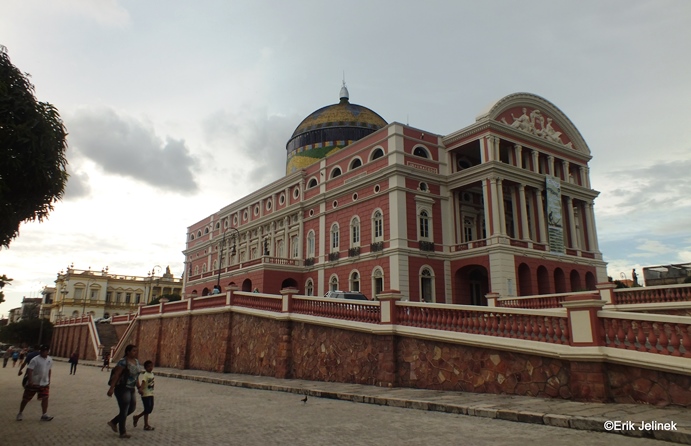
The Gran Sabana continues for several hundred kilometres south of Santa Elena. The Brazilian border though is much closer. It's so close, and so porous, that regular taxis shuttle back and forth from Santa Elena and don't even bother stopping at immigration. I only realised I was in Brazil when the driver told everyone to get out and I had to walk back to the border post to get my entry stamp (I didn't bother with the Venezuelan exit stamp though, so as to save as much precious space in my passport as possible). The Brazilian savannah is much like the Venezuelan one: dry, dusty and sparsely populated by Pemon, the same indigenous tribe that lives across the border. The main industry consists of smuggling heavily subsidised Venezuelan petrol across the border and selling it in Boa Vista, the nearest town of any note. The Brazilian authorities probably turn a blind eye to it as it saves the government substantial sums of money and provides employment in an otherwise neglected corner of the country. It's a further 1000km due south before you get to Manaus, the first major city. 1000km and you're still very much in the north of the country. Brazil's a big place.

The grandiose Teatro Amazonas, an extravagant masterpiece of European high culture in the middle of the rainforest.


Saturday, September 22, 2012

End Of Indo

From Flores I caught the weekly ferry to Kupang in West Timor. I was unable to explore Flores all the way to its eastern tip as I would have liked because I had only one week left on my Indonesian visa and still needed to procure my East Timorese visa. Extending my visa was no longer an option for the frustratingly banal reason that I had no free space large enough in my passport to accommodate another extension stamp. I am, however, blessed with dual citizenship and so am able to carry on for the time being now that I've had my British passport shipped out to me. The West Timor immigration department has a wonderful website where you can apply for your visa online by filling out a form and e-mailing it to the address provided. The process has a single, but fatal, flaw. It doesn't work. I sent off my completed form four weeks ago and, despite several efforts to make contact, including a heart-rending sob story, could just have well have sent it into a black hole for all the feedback I got. So instead I had to resort to Plan B and turn up in person.

International man of mystery: which passport shall I use today?

Friday, August 10, 2012

Spiceworld

Indonesia is made up of around 17,000 islands. Some are huge, like Borneo and Sumatra, whilst many are tiny. The cluster of four islands of Ternate, Tidore, Makian and Moti, each centred around a volcano and each small enough to be circumambulated in a single day, is certainly towards the small and insignificant end of the spectrum. Nevertheless these tiny islands, located some 250km east of the northeastern tip of Sulawesi in a sub-archipelago known as the Moluccas (or Malukus), were to have a huge and dramatic impact on world history, far in excess of their puny size. According to legend Helen's is the face that launched a thousand ships. These little islands did that and far more.

A view of Ternate from its twin, and eternal rival, Tidore. Little speedboats shuttle people back and forth from one to the other throughout the day.


Friday, July 20, 2012

Stuck In The Mud

It seems that Indonesia is becoming a place of reunions for me. I have no idea why, but a number of people I know are in the country at the moment and so I'm taking the opportunity to reconnect with them. Almost exactly 6 years after meeting Erika in a gorgeous guesthouse in Yazd I found her again in Indonesia's second city, Surabaya. At the time she and her partner Robin were cycling from Scotland east, with no definite goal in mind, seeing how far they could get and learning about the places along the way. They eventually ended up in Indonesia where Erika is now teaching English and quite content with her more stable situation: having a good job, a cosy house in a pleasant kampung and a circle of friends. I was glad to meet up with her again and catch up on what we had been up to in the intervening years and where we saw ourselves heading (much less clarity there). I was even introduced to some of her colleagues as they were celebrating a very British institution: after-work Friday drinks. It led to the bizarre situation where I was in the company of four other Scots, something that has probably only occurred once in the past 16 years since I left Aberdeen.

Monkey business in the kampung. Itinerant entertainers with a monkey on a chain and some music go round from neighbourhood to neighbourhood entertaining the kids with simple tricks.


Monday, June 20, 2011

The Big Apple

Apart from the general sightseeing I did have an important task to do in Almaty: get my Mongolian visa. (I know what you're thinking, "oh no, not another visa anecdote"; and I'm sorry to bring it up - although I will be brief. But visa acquisition forms a large part of a traveller's daily preoccupation - where do I get it? what documents do I need? how long does it take? do I need to do it via an agency? etc, etc - because, very simply, without overcoming these hurdles you can't do any travelling. And the whole visa system in this part of the world in particular is so arbitrary and capricious. It's a universal rule that if you get two travellers sitting down and talking together, within an hour they will be swapping visa stories. Nevertheless I shouldn't complain, as getting into the EU or United States with a passport from Central Asia for simple tourism purposes is nigh on impossible. But back to the story...) So I made my way to the embassy, which is very inconveniently located in the southwest corner of town in a random residential area down a very nondescript little alley, on Monday morning, only to find a little, handwritten sign tacked to the gate saying that the embassy would be closed until Thursday. I was not impressed.

My view of Almaty, with the ever-present Tian Shan mountains behind decked in an approaching thunderstorm. One of my first pics with my new camera - obviously I need to learn how to use it properly.

Tuesday, March 29, 2011

Life Is A Picnic (But Then Again Sometimes It Isn't)

The No Ruz (New Year) holidays were the perfect opportunity to visit my extended family in Tabriz. Although my immediate uncles and cousins are from Tehran the family is originally from Azerbaijan (not to be confused with the country of the same name, which traditionalist Azeris claim has stolen their identity). I love going up there as I get swamped in various second and third cousins numerous times removed, all laughing, smiling, joking. I don't get much of what's going on as everyone is speaking Turkish (Azeri) and I understand very little of what's going on, although pertinent exchanges get translated into Farsi for me. Not that it matters much as my main preoccupation is trying not to burst from all the baghlava, dried fruit and nuts, kebabs, sweets, rice and dolme that is coming from all angles as I'm carted from one family get-together to another. Luckily I do know how to say yemiram (I can't eat) to counter the insistent cries of ye! ye! (eat! eat!) of Azeri matrons for whom hospitality is second nature.


Typical Iranian picnic: park car by side of the road, unload boot, grill kebabs right there.


Tuesday, January 04, 2011

Midnight Express

I got a great New Year's Eve present upon my return to Ankara: my Iranian visa! My joy, however, was tempered by the fact that it is for only 30 days rather than the 90 I had asked for, and so will require further bureaucratic machinations once I get to Tehran. But for the time being those worries are purely academical: I had my foot in the door and was in a hurry to get going ... after a New Year's party in Ankara, of course. After my prolonged stay in the city I had made a few friends which made seeing in the new year more pleasant and normal, and also gave me an opportunity to have one last party before the enforced temperance of stricter regimes.

I had committed the cardinal sin of drinking by mixing my drinks, and so arose on New Year's day with something of a hangover despite not actually having drunk that much the previous night. Luckily I only had to pack my rucksack and walk some 3km to the train station by 4:40pm, when my train was due. I was excited to try out the Turkish railway system as I find that trains are invariably more comfortable and afford better views than buses. That's a big ask here as Turkish intercity buses are more comfortable and pleasant than any in Europe; in fact the only country where I've experienced better buses is Argentina. But I certainly wasn't disappointed on either count: there are only three seats to every row and plenty of legroom besides making dozing off a certainty. And the mountain scenery of eastern Anatolia, clad in its winter finery is worth the trip alone. Where I wasn't too impressed was the speed. Despite being called the DoÄŸu Ekspres, the scheduled time for the 700km trip to DivriÄŸi is almost 15 hours (i.e. an average speed of under 50km/h). My train was 2.5 hours late. Must work on punctuality!


Magical Winter landscape seen from my train window.


Thursday, December 30, 2010

Things To Do In Turkey Whilst Waiting For Your Visa

It looks like when the guy at the Iranian consulate in Istanbul told me that the visa application process would be easier if my family initiated proceedings in Tehran, he was being economical with the truth. It would be easier for him, meaning less paperwork, but far more complicated, more time-consuming, and more fraught with uncertainty for me. I learnt this from a Dutch-Iranian couple who were also waiting for a visa at the Ankara embassy, and who had already applied, and been rejected, a couple of times already, who were in pretty much the same boat as me. As I waited for the visa juggernaut to come to town, to retain my sanity, and to relieve Can from me squatting his laptop, I've taken a couple of trips from Ankara (having already seen all there is to see in the city itself).

The tomb complex of Rumi in Konya.


Thursday, December 23, 2010

The Two Sides Of Angora

Despite my best efforts I've been held up by the Evil Visa Fairy whilst here in Ankara. My biggest problem is that the application process is not at all transparent and every person seems to give you very different information and expectations. If it were just a question of filling in a form, paying a fee and waiting a set length of time I would be happy: I would know exactly what is expected, when it will be resolved and so could plan accordingly. Not so here. In Istanbul I was told that someone from my family would have to get me an invitation number from the Ministry of Foreign Affairs in Tehran. And I had the bad luck to need this during Ashura when government offices were closed for a week. But finally, after several visits, my uncle was able to secure an invitation number for me. According to the Istanbul consulate this would be all I need to be issued my visa. So, full of hope (one would think that I'd have learnt by now not to be hopeful with visas until I get the thing physically stuck into my passport), I made my way to the embassy in Ankara (as I had moved on from Istanbul by now). The people at the consular section didn't seem to be aware of this way of applying for visas, but I'm too far gone along this path and so am waiting for them to receive some sort of acknowledgement from Tehran. Every day I wander over to the embassy to see if the situation has improved. I'm reminded of having to wait in Bamako a couple of years back for my Mauritanian visa.

Desperately looking for my visa (statue of Turkish soldier in Ankara).


Wednesday, November 24, 2010

Thwarted

Sofia is quite a new capital and so isn't doted with many grand, historical buildings and monuments that one often expects of capital cities. Apart from a few museums and a couple of churches there isn't much to detain you in Sofia for long. The city's main sight isn't actually in the city, but towers over it. The Vitosha massif rises straight from the southern suburbs and reaches a respectable 2290m. Cable-cars get you a good chunk of the way up and the place is well-endowed with marked paths so it's highly popular with urbanites who go up en masse to escape the rat race, if at least only for a day. I did, nevertheless, stay for a while, partly due to the Monday Curse, and partly because I wanted to confront an obstacle that I have yet had to deal with whilst travelling in Europe, but which will become more common once in Asia: visas.

Even this dog didn't find much interesting about Sofia.


Thursday, September 02, 2010

Borders And Borderlands

Apart from the crossing from Finland to Estonia border crossings have so far led to only very subtle changes. Not so coming to Ukraine. First of all there actually was a border crossing, as they have all but disappeared from within the Schengen Area. Not only is this the frontier of Schengen, but also of "Fortress Europe", and the Slovak border guards were pretty thorough, going so far as to check the level of petrol in the tank (I was given a ride by a Ukrainian anaesthesiologist who works in Slovakia - just as eastern Europeans from the EU go west in search of better-paid jobs, so too do Ukrainians, who fill the void left behind by the departed Poles, Slovaks and Czechs). The checks in the other direction, heading into Schengen, are far more stringent, and waits of several hours are the norm. (As a slight aside, I've met a few non-EU nationals on this trip and all have commented on the difficulty of getting a simple tourist visa to visit. The process can take months and may require multiple days at embassies, extensive financial statements and interviews. All this for a simple week or two's holiday in Poland or Spain. And it's not just people from poorer countries, I've also heard of Japanese travellers - who are not known for their lack of means - being refused entry because of the unbending rules.)
Crossing borders isn't always as easy as in the Biesczady mountains where the border between Ukraine and Poland is pretty porous (here my bag is in Poland whilst I'm taking the photo from Ukraine).


Tuesday, February 13, 2007

Bureaucracy

I hate bureaucracy. Unfortunately it is an inescapable part of our modern lives. When it works it is an essential way of maintaining accountability, oversight and a degree of responsibility. When it doesn't you begin to feel like you're being crushed between the cogs of a huge, impersonal, unstoppable machine (I always picture Charlie Chaplin in Modern Times). There are different forms of bureaucratic annoyance and, after having encountered them often during my trip, I have come to develop a three-tiered classification of the different types.

The first is Paper Bureaucracy, where the amount of time and effort needed to accomplish a task (like buying a train ticket) is disproportionate to the desired result. This form of bureaucracy usually involves being shunted from one office to another and filling out repetitive forms in triplicate. This type of bureaucracy is the least offensive and, as long as you tick all the right boxes, you eventually reach your goal. The second form is By The Rulebook bureaucracy where an individual (invariably very low down the pecking order) has been given instructions which they will not deviate from one iota. These people's minds are impervious to reason and logic and the rules will not be bent no matter how ridiculous they may be. If you are lucky and persistent enough it is sometimes possible to wear them down or at least get to talk to a superior who is able to grant some leeway. It is the last form of bureaucracy, which I call Little Emperor Bureaucracy, that is the most pernicious and difficult to deal with. In this form people who occupy a bottleneck position in the system (and again, these people can be, and often are, near the bottom of the pile hierarchically) seem to gain an inflated view of their own importance. They often administer their own form of arbitrary justice and follow protocol according to their whim with no rhyme or reason. And because they are the gatekeepers to your advancement you are obliged to jump through their hoops (which can include baksheesh, though thankfully I haven't come across that yet). Just pray that one of these Bonapartes doesn't take a dislike to you because then you are screwed.

That is, however, exactly what happened to me at the Ethiopian embassy here in Djibouti (because after 10 days I am still here). The first time I went to the embassy I had just been released by the police and despite rushing over I was 20 minutes late. I pleaded to be allowed in to at least talk to someone, get some information or at least get the application form. The guard at the gate stubbornly refused and after the stressful time at the police I uncharacteristically broke down and made a bit of a scene (in retrospect I believe all my subsequent problems may have stemmed from that). The next morning when I turned up bright and early I was calm and polite. The guard took my passport in and returned a few minutes later telling me I could get a visa at the border. Because I had been given the same information at the embassy in Sana'a I didn't press him too much on it. So, happy and cheerful, I booked my train ticket and packed my bag.

It turns out that 3rd class is just an empty freight carriage with a lot of people sitting on the floor. We arrived at the Ethiopian border in the middle of the night and I hopped out with my passport and $20 in hand. However, visas are not issued at the border and I was detained whilst the train carried on. In the morning there followed a bunch of repetitive conversations all along the following lines:

"Where's your visa?"
"I went to your embassy in both Djibouti and Sana'a and they told me that I could get a visa at the border."
"Why didn't you go to the embassy in Djibouti?"
"I did, and they told me that you would provide me with a visa."
"No, we don't issue visas. You should have gone to our embassy."
"But I did!"

I was told to wait (I've been doing a lot of that lately) while someone would contact their superiors in the central immigration office. At 4pm I was given the unsurprising news that I was being sent back to Djibouti. So the next day (actually I had to wait an extra day as it was the weekend) I went to the embassy to apply for a visa, again. The guard still wouldn't let me in and told me that I couldn't get a visa there. No explanations, no reasons, nothing. I was seriously annoyed and confused. Everybody I've met has told me that getting visas for Ethiopia is a simple formality and can be done in a day and here I was being totally stonewalled. So instead I got someone to collect and hand in the application form on my behalf. That proved unproblematic. But upon going to collect it the next day I found out the application had been refused because I had no residence or work permit for Djibouti, which is a load of bollocks because many foreigners have got visas here without those permits. So, for some reason I had become black-listed.

This has left me with three options, neither of which is ideal. I can either go to Eritrea instead, though there nowhere near as much to see there. I could fly into Ethiopia and get the visa at the airport, but that would go against my no-fly principles, cost a lot of money ($120) and I might even be refused a visa once I get there. Or I could even try to catch a boat up to Egypt, though I would miss out on some interesting countries along the way. I am mulling over my options, but in the meantime I am exceedingly grateful to the guys at Dolphin Expeditions (Bruno, Nicolas and Vicente) who have let me crash at their place for free during all this time, and not only that, but have also fed me and generally put up with my oddities as well. Without their help, support and generosity I really would have been up a creek without a paddle. (If anyone is planning to head to Djibouti they are the ones to get in touch with to organise trips and scuba diving in the area.)

Saturday, October 21, 2006

Spanner In The Works

My plan from Turkey was to head south for the Winter, to Syria and the rest of the Middle East, where my lone jumper and single-season sleeping bag would suffice. So I made my way to Gazi Antep, the largest city in southeast Turkey, where Syria has a handy consulate. And on Friday morning I bounded over, passport in hand and smile on my face. The smile was soon erased when the man behind the counter jabbered at me that I needed a letter. Uh-oh I thought, remembering the last time I needed a letter for a Pakistani visa in India the process cost me a lot of time and, more importantly, money. And here the situation was exactly the same ... except that there is no British consulate in Gazi Antep.

"No problem," insisted the Syrian lady, "they can just fax it through like everyone else." Except Britain, as always, refuses to do things like everyone else. "We can fax it through alright," said the lady at the British embassy over the phone, "but you'll have to come over here and pay for it in person." (The pro forma letter, incidentally, costs significantly more than the multiple entry visa for Syria, whereas other countries' embassies give them away like candies on Hallowe'en.) I pleaded my case, I got down on my hands and knees before the vice-consul (figuratively speaking as it was over the phone) but she would not budge from her position. And I refuse to travel over 1000 miles to collect the letter, partly because it would be horribly expensive (some $250 or more), but also because I am too proud to submit myself to such illogical, frivolous and petty box-ticking when a plain and simple solution is so glaringly obvious. And so, my dear readers, my best laid plans have well and truly gone agley. But what pisses me off the most is not the thwarting per se, that I could have lived with, if it was done by some overbearing, autocratic bureaucracy of a repressive regime. No, what really gets my goat is the fact that my dreams are denied by my own government who are supposed to be there to help me if I encounter difficulties abroad, not produce them. And I pay taxes for this? (I assure you that I have paid taxes, at some point) It almost makes me sick enough to renounce my citizenship. My only hope to get into Syria now is to just turn up at the border and pray that my innocent, puppy-dog eyes (and perhaps an appropriate "facilitation fee") melt the border guards' hearts. I wouldn't hold my breath though.

Anyway, that's enough of my moaning. Seeing as this is a travel blog I really ought to write a little something about my surroundings for those of you back home. Gazi Antep is the materialistic slut to Urfa's Amish housewife. Gone are the headscarves and skullcaps to be replaced by expensive hair-do's and rudeboys in pimped up cars and blaring music. Here is the last bastion of western Turkey before the wild wild east begins. As such Gazi Antep offers little for the casual tourist, except for one thing: its museum. The ruins of Zeugma were known about for some time, but when a dam was slated to submerge the site under its reservoir work got under way to properly excavate the ancient city. It turned out to be perhaps the most significant Roman ruins since Pompeii. Thus started a frantic race against the clock to save as much as possible before being lost under the rising floodwaters (because nothing as poncey as archaeology could ever stop the Turkish government from building a dam). Of all the treasures that could be saved the most stunning are the immaculate mosaics which are by far and away the most beautiful ancient mosaics I have ever seen (a bit of a disingenuous statement perhaps as I have not seen any other ancient mosaics, but even if I had I am sure the statement would still be true). It is also rather fitting, now that most of the city is under water, that the showpiece of the entire collection is a huge mosaic of Poseidon.

Sunday, April 09, 2006

Subtle Hints

I have finally applied for, and received, my Pakistani visa and now have my sights set on the border and the adventures beyond. Not before time too, as India is letting me know in various subtle, and some not so subtle, ways that I am beginning to outstay my welcome. First of all I was robbed; and by somebody I knew and trusted nonetheless.

"This is to introduce Mr Erik Jelinek holder of British passport no. ... issued by ... Mr Jelinek has stated that he wishes to travel to Pakistan for tourism purposes. I would be grateful if you would give his visa application due consideration."

That is a verbatim copy of the "letter of introduction" that my embassy charged me £41 (at £1 per word it cost me more than my average weekly budget for India) for, and which the Pakistani embassy insisted upon. What arcane, bureaucratic ritual it is required for is completely beyond me. Then, whilst sightseeing here in Delhi, I was shoved out of a local bus. It would have been OK if it wasn't moving at the time, but, as it was, I got a nasty graze on my arm (pretty lucky considering it could have been considerably worse) and significant blackening of my mood for the day. And the touts and rickshaw-wallahs are more rapacious here than anywhere else, mainly because Delhi is the point of entry for many people and so they are generally less wise to their ways. And then there's the heat. Of late the thermometer has been pushing into the 40 degree mark sucking the enthusiasm and drive to do anything out of me. So the mountains of Pakistan will be a welcome and fresh change for me. But it hasn't been all bad. Delhi has its fair share of informative museums and old, historic wossnames to keep you busy for some time. My highlight, however, was neither of these, but instead a modern building, possibly the most beautiful post-war construction that I know of: the Baha'i lotus temple. Although the Baha'i religion is relatively new and unknown to many people they certainly have made their mark with this exquisite masterpiece.