Showing posts with label China. Show all posts

Saturday, November 10, 2012

Pics 2 (Asia)

It took me almost exactly 19 months to zig-zag my way from Turkmenistan through to Australia. As the largest continent, and cradle of civilisations there is plenty to see, taste, explore and experience. I have had innumerable encounters with unfailingly lovely people, made some life-long friendships, tried a plethora of strange dishes, witnessed some spectacular(ly odd) ceremonies, seen breathtaking landscapes, and learnt  much about culture and history that have allowed me to understand the world a little bit better (I hope). I also hope that this knowledge has made me a better, wiser person

Mushy introspection aside Asia has been an agreeably cheap destination (apart from North Korea) and I've managed to average a daily spend of £11, of which I'm quite proud. That average will definitely not hold out in the following months though. I've also picked out a selection of some of my favourite photos (in no particular order) from the past 19 months that I haven't previously used in any of my posts. Some of them perhaps have some deeper meaning or political significance, whereas other I just found beautiful. I hope you like them as much as I do (what are your favourites? are there any that you particularly like? If so feel free to let me know by leaving a comment.).


Mongolian girl.

Monday, January 16, 2012

Being Choosy About The Choice To Choose

As I mentioned in my previous post my time here in Taiwan has coincided with election season. In western Europe elections are not particularly visible to the casual visitor going about their daily sightseeing. The same cannot be said for Taiwan. Posters supporting this or that candidate, with the number to tick on the ballot paper prominently displayed, occupied every free bit of wall space and every lamp post, even in the meanest little village. Everywhere volunteers in blue waistcoats can be seen canvassing and handing out fliers whilst scooters and vans with loudspeakers diligently plough the streets declaiming to all who will listen the merits of their party over the other.

Election flags outside the KMT party offices in Taichung. The incumbent president, Ma Ying-jeou (on the left with a corny "fist-pump" gesture), was running for a second term.


Wednesday, December 28, 2011

Getting To Taiwan The Slow Way

My dream is to be able to complete my trip, travelling round the world, without needing to resort to flying. It will be difficult to accomplish, and almost certainly be more expensive and take longer than if flying, but I feel that airplanes have somehow trivialised distances so that we no longer really appreciate how far away places are. And when travelling by plane from point A to point B you do not see what is between them, how the land changes, how cultures, traditions and people connect the two. Furthermore flying is also the most polluting form of transport (per kilometre travelled) out there. (And in one of the world's ironies/hypocrisies, it is also the form of transport that is taxed the least, thereby benefitting the most affluent as well as the most profligate polluters.) The dream may not work out, but I will certainly try.

The fearsome Taiwanese army, ready to fight off any invasion from Commie China ... OK, maybe not. But they did help me cut my way through the bureaucracy of buying a SIM card in a 7-Eleven on Matsu.


Saturday, December 24, 2011

Big Trouble In Little China

Over the course of this and previous trips I have spent about four and a half months in China. A long time perhaps for a single country, but not that long when you consider its size, history, and the fact that it is home to one sixth of the world's population. In my time there I have mastered the use of chopsticks (well, perhaps not mastered, but I certainly won't go hungry), picked up a smattering of Mandarin, speaking as well as reading, developed a liking for red bean ice-cream (and red beans in general) and learnt a good deal about it. I now feel pretty comfortable travelling in China, which has a surprisingly comprehensive rail and bus network, finding accommodation, buying food and generally being a tourist. I can even ask some basic questions, although I will rarely understand the replies unless they are accompanied by hand gestures. I have come to really enjoy the (street) food and find it hard to let a day go by without satisfying my hunger for baozi. All in all my impression of China is very positive, yet there are some things that grate on me and (I feel) are intricately linked together.

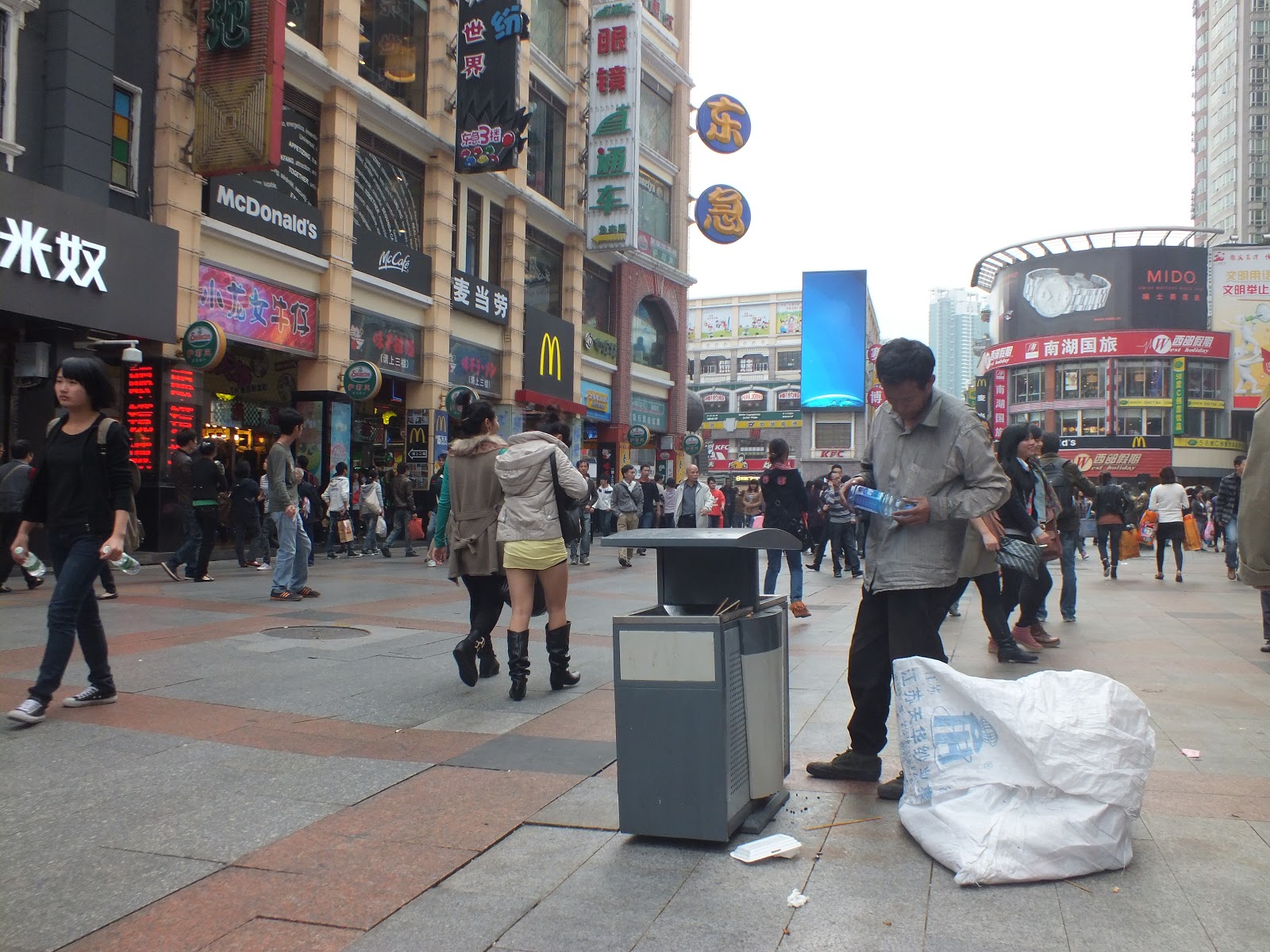
In China's breakneck growth many have seen their quality of life vastly improve, but there are also many that have been left behind.


Friday, December 23, 2011

Hidden Stories Of Fujian

One of the things I love doing when travelling is finding little-known, obscure vestiges of history. Places that hark to a past that is not talked about, forgotten or, better yet, actively suppressed. I'm not really sure why, perhaps out of a desire to witness a truth that is being denied and thereby keeping it alive, or perhaps to satisfy my own curiosity about disputed pasts and to make up my own mind. Whatever the reason I am drawn to the forgotten stories, even though there is often little there to actually see. Some examples include the multitude of Armenian remains scattered throughout Turkey, many of which were actively destroyed, damaged or converted by successive regimes to deny, or at least reduce, a historical Armenian presence; or Palestinian towns within Israel that have been removed for the same reasons; Jewish remains within the Middle East or the Pale of Settlement where there had been communities for centuries but no longer today; or Communist-era follies in eastern Europe.

The Great Helmsman has a lot to answer for. The omnipresent cult of personality is gone, as is his Little Red Book (which is surprisingly difficult to come by in China, although, oddly enough, pretty easy in Hong Kong), though a number of statues still remain. This one in Fuzhou is one of the most conspicuous.


Sunday, December 18, 2011

The War For Drugs (And Tea)

Today's post is a little different from my usual ones. It's not about my travels as such (and there are no photos), but instead is about a piece of history that I have learnt whilst travelling that I didn't know and thought it important to share.

Although the most important factor making Hong Kong such a stress-free destination is the fact that most people speak English to some degree, and many often well, thanks to Hong Kong's past as a British colony. Many people like to pin all the world's ills on colonialism and its legacy, whereas I believe that is too easy a cop-out. Colonialism was often racist, mercenary and exploitative, but it also helped less developed societies to leap forward. Hong Kong would probably be the poster child for positive colonialism: a rich, dynamic and open society that is now ploughing its own furrow. Of course, what is often forgotten, is just how Britain came to possess Hong Kong and how China opened itself up to the outside world. That little episode in history is known as the Opium Wars, and is one of the darkest passages in Britain's history, and one that gets very little air-time.

Thursday, December 15, 2011

Bright Lights And Big Bets

At the mouth of the Pearl River, on either side of the estuary, lie Macau and Hong Kong, former colonies of Portugal and Great Britain respectively. And although they were returned to China (in 1997 in the case of Hong Kong and 1999 for Macau) they still remain administratively and politically separate from mainland China under the "one country two systems" policy and are classified as Special Administrative Regions. They are free of the all-pervasive Chinese censorship; travelling abroad is far easier; they tend to speak Cantonese rather than Mandarin; and use traditional Chinese characters to write rather than simplified characters. In fact in some ways they are more Chinese than their mainland brothers as they have retained some traditions that were purged during the tumultuous years of Mao's China. The ex-colonies are also easier to visit for foreigners than for ordinary Chinese who need a special permit to visit the SARs.

A small shrine outside a shop where incense is burnt and often a food offering (e.g. an apple or an orange) is left is a common sight in Macau and Hong Kong, but almost extinct in mainland China.

Friday, December 09, 2011

Where Can I Buy 4000 Pairs Of Shoes?

I finally made it to Guangdong province on China's southern coast. The palm trees are here, as are the bananas, but the warm balmy weather is still eluding me. The name Guangdong may sound unfamiliar to Western ears, as it is more commonly known as Canton. During the 18th and 19th centuries when the Western powers were expanding their influence around the world their main point of contact with the Middle Kingdom was through the various ports in the province, particularly Guangzhou (which was also, confusingly, named Canton). This is the Chinese region that has had the greatest contact with the outside world and has always been more open to foreign influences, which is easily evident both in its people and its places.

A poignant reminder of China's bygone openness to the world. This minaret stands in the grounds of a mosque in Guangzhou, built in the 7th century AD, and therefore one of the oldest mosques in the world. There is still a significant Muslim population throughout China that traces its history back t those early days.


Saturday, December 03, 2011

Chinese Landscapes

I remember, as a child, seeing traditional Chinese landscape paintings. I remember thinking to myself that they didn't look real: they were permanently misty and the mountains looked like caricatures, sort of ideal mountains that a child would draw, but far more "mountainy" than any real mountain. They didn't look like anything I had ever seen in Europe and so I simply dismissed them as fantastical make-believe landscapes ... how wrong I was.

Yangshuo's iconic karst scenery and idyllic rivers make it one of China's most popular tourist destinations, and for good reason.


Saturday, November 26, 2011

Winter Migration

Zhengzhou was getting too cold for me, with nighttime temperatures plunging uncomfortably close to freezing and the hazy days faring little better. Exacerbating the situation was the lack of indoor heating that prevails in most of China - people just put on more clothes when they're at home in the evenings. There was only one solution: I bought myself a train ticket, direction due south. The scenery rolling past the train (when you could see through the endless mist) was one of small, steep hills with isolated villages surrounded by paddy fields, now denuded and home only to stubble and the odd, rather lost-looking, water buffalo. As soon as I stepped off the train in Wuhan I knew I was headed in the right direction and I was even able to take off my beanie, which had become a permanent fixture on my head since returning to China.

Like many large Chinese cities Wuhan is undergoing a boom that is seeing a rise in local investment and consumption. So far 4 of the cities I have visited have metro systems under construction and many are also building swanky shopping and leisure districts such as the one above that has regenerated an old canalside.


Monday, November 21, 2011

Cradles And Graves

500km inland from Qingdao lies Zhengzhou, the capital of Henan province. The province's name means "south of the river", in this case the Yellow River, and is without a doubt the cradle of Chinese civilisation. Within a relatively small radius lie the remains of over a dozen capitals of previous dynasties and kingdoms, most of the buried under countless layers of silt deposited by the continuously flooding river. For archaeology buffs it is the region to visit in China.

Zhengzhou itself is a large, hectic city of over 8.5 million people (more than Greater London) that, despite its long history, has little to show for it. But as a major railway junction it is a handy base from which to explore the surrounding region and travel back in time. If you want to work chronologically your first stop should be Anyang to the north of Zhengzhou, a rather nondescript and drab city, but sitting atop the ruins of the ancient Shang capital. Dating back to 1400 BC the ruins represent the very start of Chinese history as well as the origins of the Chinese writing system. Thousands of bones and turtle shells have been unearthed bearing the characters that would give rise to modern hanji script, and although most of them are too far removed to be recognisable, the few that have traversed the millennia almost unchanged elicit goosebumps as you feel the ancient world communicating directly to you. The succeeding Zhou dynasty moved the capital to Luoyang, west of Zhengzhou, where the historic remains include more than just excavated earthen walls and tombs with ritual sacrifices. The most noteworthy are the Longmen Grottoes, stretched out along either side of the Yi river. Here generations of Buddhist monks carved shrines and temples into the rock, from the tiny to the grandiose, with the central Buddha reaching over 17m, over a period of 300 years. Most of them survived unscathed until the beginning of the last century when the combined effects of Western collectors, Japanese invaders and the disastrous Cultural Revolution defaced the majority.


The main temple of the Longmen Grottoes with its 17m central Buddha carved from the cliff face.

Wednesday, November 16, 2011

Not Quite Bavaria

I left Japan via Shimonoseki's ferry terminal, my port of entry to the country. It wasn't something I had wanted to do but there was no other option if I didn't want to fly. Not only was it my first and last stop, but the last person I saw in Japan was also my first: by chance I ran into my host from my first days in Shimonoseki, Seiji, who was seeing off another guest (a Mexican named Homero) who was also headed to China on the same boat as me. It was nice to have someone to talk to among the 24 other passengers (all of them, from what I could gather, Chinese working in Japan) on the 29 hour passage to Qingdao as entertainment options on the ferry were limited to a single channel of Chinese TV, a meagre onboard library of half a dozen foreign books, and taking long, hot showers and soaking in the public bath.


The ferry bathroom where I spent a considerable chunk of time on the crossing from Japan to China, simply because there was little else to do, and baths are a rare luxury on the road (figuratively speaking, of course), to be taken whenever the opportunity presents itself.

Sunday, October 30, 2011

Eastern Elegance And Eccentricity

It's no revelation to say that the cultures of the Far East (by Far East I mean China, Korea and Japan) differ quite markedly in many ways to European, and even Middle Eastern, cultures. I have become particularly intrigued by the Oriental sense of aesthetic - perhaps also because the aesthetic has a clear, external manifestation, whereas it's hard for me to be able to talk about how people actually think and what they believe. The Oriental view (and I am writing this as a layperson who hasn't studied this at all, but more from my observations and experiences whilst travelling here) emphasises a holistic harmony and balance, which we see, at the most basic level, with the complementary forces of yin and yang.

The ultimate expression of Far Eastern  esoteric harmony: the Japanese karesansui (dry landscape) garden, heavily influenced by Zen Buddhist principles. (The garden in the picture is at Ryoan-ji temple and is perhaps the most famous example of the style.)


Thursday, September 22, 2011

Seoul Of The Country

Although I had very briefly been in South Korea whilst visiting the DMZ at Panmunjon, if I wanted to get there properly I had to go via China. So back it was to Dandong where I bought myself a ferry ticket to Incheon, Seoul's port city. It would have been cheaper and faster to fly, but I'm wanting to try to travel round the world without having to resort to airplanes as much as I can at least; plus in an airplane you don't get the opportunity to share a giant dorm room with over 100 Chinese.

Travelling economy class in China means something completely different to what we're normally used to. The convivial atmosphere of the large dorm aboard the ferry to Incheon.


Thursday, September 15, 2011

Completing The Axis

Whilst in Dongbei I visited the towns of Ji'an and Dandong, on the banks of the Yalu river which forms the border with North Korea. Staring out across the divide is like looking through some sci-fi time-vortex: the Chinese side is bustling, noisy, full of lights, shops, cars and the shouting mass of Chinese humanity, whereas just over the slow waters the other bank is moribund and lifeless with barely a soul stirring. As night falls there is barely a light to be seen in the enigmatic Hermit Kingdom. At the Hushan Great Wall (the easternmost section of the Great Wall which reaches right to the DPRK border) the Yalu river narrows to such an extent that the Korean border fence is only 10m away. Getting so close there was no way I was going to pass up the opportunity to visit what is perhaps the most intriguing and isolated country in the world today (with the possible exception of Eritrea) whilst also completing my tour of George Bush's infamous Axis of Evil.

The Yalu river a Yibukuo where it narrows to less than 10m. The left side is China, whilst the right is North Korea.


Tuesday, September 06, 2011

A Life More Ordinary

From Beijing I headed up to the region historically known as Manchuria. Today though in Chinese it is simply called Dongbei, or Northwest (actually, to be more accurate, Eastnorth), a far more neutral term as Manchuria is the cradle of several unhappy episodes in Chinese history: first there was the disastrous Manchu Qing dynasty that oversaw the stagnation and decline of China; and then Manchuria became the backdoor through which foreign empires, first Russia and then Japan, invaded. It's not a particularly touristy area, its major draw is the imperial mountain resort at Chengde which is popular with locals (and shows that there is a sizeable affluent middle class with disposable incomes, as the entrance ticket costs almost $20 regardless of nationality and with no reductions, even for people with fake student IDs). Even though I arrived at 8am the place was already thronged with families on weekend breaks, tour groups with matching T-shirts and baseball caps and, particularly memorable, large groups of older women doing undemanding dance routines to easy listening music. Old-timers in China are surprisingly sprightly, and it's not uncommon to see them doing tai-chi, singing karaoke or even kicking about a shuttlecock in a city park.

The "Small Potala Palace" in Chengde. Initially the Manchu emperors felt more affinity to their Mongolian and Tibetan cousins and built temples in their styles and used Mongolian script. But as time went on they became more Sinicised and looked down on them.

Friday, September 02, 2011

Staring At The Sun

During my first week in Beijing the sun, when it was visible, was a faint, brighter dot in the city's enveloping haze. An apt symbol for the sea-change between Mongolia and China. The former has wide, open spaces with barely a soul in sight, the calm serenity and blue skies only broken by the whup-whup-whupping of a crow's wings as it passes overhead (when was the last time you heard a bird's wing beats?). Beijing is another planet entirely: loud, chaotic, bustling, choked with traffic, pavements spilling over with street vendors, air wafting with odours both salivating and unpleasant mixing with the sweat of humanity brought on by the humid summer. Beijing out-populates Mongolia by four to one (despite being only one thousandth the size of the latter). The smoggy haze is an inevitable by-product.


The obligatory holiday snap of the Gate of Heavenly Peace (Tian'AnMen) at the entrance to the Forbidden City, along with its portrait of Mao and watchful soldier.

Thursday, August 25, 2011

Between A Hammer And A Sickle

Heading southeast from UB towards the Chinese border the monotonous landscape is broken by a few small, run-down towns amidst the unending, patchy steppe. (The curious thing about the Mongolian steppe is that, when seen from a distance, it looks lush and green, but up close you discover that there is in fact more barren ground than there is vegetation.) Pretty unassuming and rather boring by and large, although there is a wonderful curiosity just off the main road. Not signposted or marked on any maps and surrounded by a rusting barbed-wire fence some 25km north of the town of Choir are what is left of what was once the largest Soviet airbase. All the jets and really exciting equipment has, of course, been taken away, but the 50 or so domed hangars and slowly crumbling support and command buildings are still there, testament to both the sway that the Soviet Union once held over Mongolia, as well as to the frostiness of relations between the former and the other great Communist power, China. Although the site is abandoned militarily, a handful of families occupy the base with their gers and herds of goats, their only reason for being there to shoo out pesky tourists who come nosing around (why I have no idea). So although I managed to sneak under the barbed wire without much problem and even poked around a few of the hangars I was inevitably caught (ambling around with a 20kg backpack is not particularly stealthy) and politely escorted off. A shame, as there's certainly a business opportunity going begging there.


One of the hangars in the abandoned airforce base outside Choir. Once they housed MiG 25s, now they just house goats.