Showing posts with label Dichotomies. Show all posts

Friday, October 24, 2014

A Desperate Despot?

For the "last dictatorship in Europe" I was surprised that I could arrive in the heart of the country without having my passport checked. It's funny how that sobriquet, bequeathed during George W. Bush's presidency, has come to stick to any and every mention of Belarus and its leader Alexander Lukashenko (not that they get many mentions in the world's media). After spending just a few days in Minsk talking politics with almost everyone I met (locals are far more world-savvy and open with their views than one would imagine), I realised that it's an over-simplification that obscures looking at the country realistically (for an idea of the sort of journalistic hatchet-jobs out there you can read this recent article in GQ). Sure, there's no denying Lukashenko has a tight grip on power, political dissent is only permitted within narrow limits (as attested to by the number of people behind bars for their contrary political views), and there is more than a little corruption to be found; nevertheless these truths need to be tempered with others that don't sell as many newspapers.
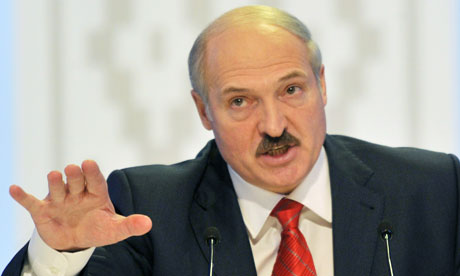
"Just wait a sec, I haven't told you the punchline yet." Belarus's notorious president Lukashenko sporting his trademark moustache. [Source: Guardian.co.uk]

Saturday, November 23, 2013

Rusty

That America is the richest country in the world is well known. It manifests itself in towering skyscrapers, the car culture, its gargantuan military, its army of labour-saving devices, the dominance of Wall Street and American corporations throughout the globe, and, of course, the American Dream. Convenience is king, and, if you have a decent job, life is comfortable and easy. This big, bold brashness is evident in Chicago, the Windy City, and acknowledged capital of the Midwest. Lazily sprawling westwards from the shores of lake Michigan, the skyscrapers of the Loop (the central business district). Indeed, although may think of New York and Manhattan when talking of skyscrapers, it actually Chicago that is the spiritual home and birthplace of the skyscraper. The first steel-framed skyscrapers were built there; the revolutionary tubular design that allowed even taller, more efficient towers was developed there; and of course it is also home to the Sears (aka Willis) Tower, which, up until recently, was the tallest building in the Americas.

The lakefront skyline of Chicago with its huddle of skyscrapers.

Saturday, November 16, 2013

Paradoxysms

Countries often have deep, internal divisions that cleave the society in two. Often the divide is between a poor, religiously conservative rural population, and an urban, middle-class, educated, liberal one. I found this particularly apparent in countries such as Iran, Turkey and China, which are still undergoing transitions towards more industrial economies. In America the transition has occurred but the division still exists to a large degree, and somehow the rural poor have been duped into voting for rich corporate interests. But taking pot-shots at American political dysfunctionality and woeful health provision is too easy and instead I want to look at the quirkier paradoxes and polarisations that exist within the US.

For poorer Americans access to fresh fruit and vegetables is not only severely restricted, but food education is of a very low standard. Whilst wandering the African-American museum in Chicago I stumbled across this educational play aimed at younger children about the benefits of fresh fruit and veg using hip-hop and gospel music. Here the hero (a broccoli) is being led astray by a couple of rashers of bacon. (Though it seemed to me that the bad foods had the best tunes.)

Monday, November 11, 2013

Straight Up The Middle

From Texas the logical and reasonable thing for me to do would have been to hug the southern states up until the coast before heading north to New York, so as to stay in a band of temperate weather for as long as possible. Logic is not my strong suit and so instead I headed, more or less, straight north cutting through the much-neglected Midwest. This large, flat expanse, right in the middle of America, is oft-overlooked by visitors to the country who tend to gravitate to the coasts. for me that was reason enough to visit as I was curious to uncover (if only a small part of) the hidden heart of America.

For many towns around the world 4pm on a Saturday afternoon might be considered the busiest time of the week, but not so in Lufkin, Texas, which resembled a ghost town. In the 2 hours that I walked its streets I literally saw less than a dozen other people walking.

Tuesday, April 30, 2013

A Tale Of Two Cities

Brazil is dominated by its two largest cities: Rio de Janeiro and São Paulo. The two are eternal rivals and are as alike as chalk and cheese. Rio is the star of the show, the prima donna, the cool kid on the block; whilst São Paulo is the plain one that does all the work and gets none of the credit. The images of Christ the Redeemer, Sugarloaf rock and the beaches of Ipanema and Copacabana are iconic, conjuring up fantasies of caipirinhas on the beach, suave maestros playing bossa nova into the wee hours, and harems of girls from Ipanema. This is the Brazil people dream of. The only associations people have with São Paulo (if they have any at all) are traffic jams, hordes of busy, unsmiling people and polluted air. Of course there are truths behind these cliches, but also much more.


View of the Guanabara Bay, the older part of Rio, and the unmistakable Pao de Azucar rock on the right.

Sunday, September 02, 2012

Which Bali Do You Want?

"Have you been to Bali yet?" is the question that I've been asked by almost every single Indonesian I've met in the 3 months I've been here. Although Indonesia is a vast country comprising over 17,000 islands, 300 ethnic groups and 742 different languages, I am white and ergo I must be going to Bali. If any foreigner has heard about Indonesia it is invariably about Bali. For many Australians it is their equivalent to the Spanish Costas for sun-starved northern Europeans, and their way of holidaying there is not at all dissimilar. Yes, I was planning to go to Bali I would reply, but also Sulawesi, Ambon, Flores, Sumatra and Java. There is more to Indonesia than just one island. Bali's overwhelming presence on the tourist trail through Indonesia made me resent it even before I had set foot on it. I was sure I wouldn't like it and wasn't planning on staying long.

My nightmare image of Bali.


Sunday, November 06, 2011

Megalopolis

When I first planned this trip and drew up my itinerary on the back of the proverbial napkin I had purposefully omitted Japan for a number of reasons. The first was the cost (see next post) and the second was that it was something of a dead end and would require me to double-back on myself, something I strive to avoid at all costs. In the end both concerns were justified but were unable to outweigh my curiosity for the country, its unique culture and bracing combination of old and new.


One of the most recognisable symbols of modern Japan: the shinkansen bullet train pulling into a Tokyo station.

Sunday, October 30, 2011

Eastern Elegance And Eccentricity

It's no revelation to say that the cultures of the Far East (by Far East I mean China, Korea and Japan) differ quite markedly in many ways to European, and even Middle Eastern, cultures. I have become particularly intrigued by the Oriental sense of aesthetic - perhaps also because the aesthetic has a clear, external manifestation, whereas it's hard for me to be able to talk about how people actually think and what they believe. The Oriental view (and I am writing this as a layperson who hasn't studied this at all, but more from my observations and experiences whilst travelling here) emphasises a holistic harmony and balance, which we see, at the most basic level, with the complementary forces of yin and yang.

The ultimate expression of Far Eastern  esoteric harmony: the Japanese karesansui (dry landscape) garden, heavily influenced by Zen Buddhist principles. (The garden in the picture is at Ryoan-ji temple and is perhaps the most famous example of the style.)


Sunday, October 23, 2011

8:15. The Time It's Always Been

The name Hiroshima will forever be linked in the consciousness of the world with the events of the 6th of August 1945, when the first atomic bomb was dropped on Japan, ushering in the nuclear era with a bang. A bang so large that it destroyed 90% of the city and killed almost half of its population and helped precipitate the end of the Second World War (although some academics argue that the USSR's declaration of war against Japan and invasion of Manchuria on the 9th of August was a far greater reason for their surrender). The effects of the atomic bombs on the world were momentous and too great to mention here, but in Japan it led to the pacifist constitution and a widespread national desire for peace (not that Japan doesn't have its militarist nationalists, and its continued inability to admit and apologise for, rather than regret, its World War II atrocities doesn't help make it any friends in the region). The epicentre for the peace and nuclear disarmament movement worldwide is undoubtedly Hiroshima's Peace Memorial Park where a museum, shrine, cenotaphs and statues pay moving tribute to those who perished on that fateful day. The symbol of the complex is the A-Bomb Dome. The building was an exhibition hall before the war and was almost directly below the bomb - the hypocentre, or ground zero - when it exploded (the bomb was detonated 600m above the ground so that the destructive heat and shock waves would not be impeded so as to cause maximum damage) and so its vertical walls survived the devastating blast since they were perpendicular to the shock waves. Its preserved skeleton serves as a grim reminder to what happened on that fateful day.

The empty shell of the A-Bomb Dome serves as a stark reminder of that horrific day 66 years ago.


Thursday, September 22, 2011

Seoul Of The Country

Although I had very briefly been in South Korea whilst visiting the DMZ at Panmunjon, if I wanted to get there properly I had to go via China. So back it was to Dandong where I bought myself a ferry ticket to Incheon, Seoul's port city. It would have been cheaper and faster to fly, but I'm wanting to try to travel round the world without having to resort to airplanes as much as I can at least; plus in an airplane you don't get the opportunity to share a giant dorm room with over 100 Chinese.

Travelling economy class in China means something completely different to what we're normally used to. The convivial atmosphere of the large dorm aboard the ferry to Incheon.


Friday, April 22, 2011

Sitting Down. Getting Picked Up.

Sometimes you have to travel far and go through great efforts to make rewarding contacts or rewarding experiences. On the other hand sometimes you have to just stop and sit down. I left Bukhara bound for Navoi, a town some 100km to the north, where I had booked a berth on the twice weekly Tashkent to Urgench train*. But along the way I stopped off at the town of Gijduvan, known for its shashlik, large market and medieval madrassa. When I arrived at the latter with my heavy rucksack the quiet, shady courtyard seemed like the ideal place to sit down, rest and catch up with my diary writing which I had neglected of late. I didn't get much writing done though. First the guard came over to inspect my thoroughly suspicious behaviour: "where are you from? what's your name? what are you doing? year of birth (here, rather than ask you how old you are, they ask you for your birth year)? how many children do you have? why aren't you married? The final question automatically follows the one before it and is asked with a mixture of inredulity, amazement and pity - 30 is already well past the best before date as far as Uzbekistanis are concerned. Next came the caretaker with exactly the same questions. Then the lady selling souvenirs, the odd-job boy, and finally the imam. Even local visitors would crowd round me, curious to know what this strange foreigner was doing in their madrassa with his oversized bag and his book of cabalistic scribblings. Come lunchtime I had only managed to write a couple of entries and was feeling rather peckish when right on queue souvenir-lady came over and motioned for me to a small chamber where the others were sat around a low table each with a bowl of mutton stew and several loaves of round bread broken up in the middle. There was an empty place set aside for me. And so the next few hours were spent idly chatting away with my new "temporary family" trying to make ourselves understood, and usually managing after a somewhat convoluted manner.


Hanging with the madrassa boys. Lamb stew, bread and green tea. Mmmmm!

Saturday, April 02, 2011

Persian Paradoxes And Politics

In my time here in Iran I have come to regard it as a country of paradoxes. I've already mentioned a few, such as the surprisingly good transport infrastructure paired with the complete lack of respect for road rules, and the Iranian love for camping and the outdoors, as long as they don’t have to leave their cars. Today I want to cover a few more as well as touching on some political issues. So please bear with me as this post may be slightly disjointed.

Perhaps the biggest paradox in Iran is that of its women. The overwhelming view of Iran’s women in the West is of a poor, repressed underclass, forced into submission and degradation, hidden away behind chadors and hejab. I have found the truth to be very different. First there are the simple facts: women form the majority of university graduates, they can work, run for parliament and drive cars. Significantly better than most countries in the region. Sure, there are many limits to their rights, and in theory permission from male guardians are required although often not in practice. I find the obsession of the West of the mandatory wearing of the headscarf to be very much misplaced. It is a very small, cosmetic annoyance and is the least of women’s worries in Iran (what Western media fail to report is that there is also a dress-code for men as well, which, although less restrictive, is also a reality). But then there are also the women themselves: fiercely independent, resourceful, spirited and clever they are universally the driving force within any household. They don't let the restrictions of the regime get in the way of chasing their dreams. Throughout the country I have been surprised by the strong women who are bold and outgoing and unafraid to air their opinions. Unlike their more emancipated Western sisters who take their freedoms for granted Iranian women are aware of what they have fought to earn and guard it jealously.


A simple wristband but one that could potentially get you arrested, symbolising, as it does, the pro-reform green movement.


Monday, February 28, 2011

Unexpected Diversity

Iran is by no means a homogeneous country by any measure. We've already covered the landscape and climate, but the people are a mixed bag too. Only half of the population are ethnically Persian. Another quarter are Azeri (known locally as Turks) with the other quarter made up of a motley crew of Kurds, Lors, Bakhtiari, Turkmen, Arabs, Laks, Baluchis and Mazandaranis. During this little jaunt down to the south I've met most of these different ethnic groups and although they all have their own languages, cultures and histories there is a uniting factor amongst them, and that is their Iranian identity. This pride goes far deeper than religion and the current Islamic regime and its ubiquitous slogans and propaganda: even fervent Muslims will often have a pendant or sticker on their car of a farohar, an old Zoroastrian symbol. More than once I've heard people say that they are Muslim in name only and that in fact they identify more closely with the tenets of the older, indigenous religion (for non-Muslims the bureaucratic machine can pose unwelcome hurdles). The biggest holiday is also No Ruz, a spring festival that predates Islam by millennia and which the ayatollahs, much like the Muslims who conquered 13 centuries ago, strove to ban when they initially came to power, but without success. The following encounters are a sample of the seemingly contradictory cross-section that there is within Iranian society.

A farohar over the lintel of a Zoroastrian temple in Yazd. The symbol, although religious, has been adopted by Persians, proud of their non-Arab heritage, as a national symbol.


Thursday, December 23, 2010

The Two Sides Of Angora

Despite my best efforts I've been held up by the Evil Visa Fairy whilst here in Ankara. My biggest problem is that the application process is not at all transparent and every person seems to give you very different information and expectations. If it were just a question of filling in a form, paying a fee and waiting a set length of time I would be happy: I would know exactly what is expected, when it will be resolved and so could plan accordingly. Not so here. In Istanbul I was told that someone from my family would have to get me an invitation number from the Ministry of Foreign Affairs in Tehran. And I had the bad luck to need this during Ashura when government offices were closed for a week. But finally, after several visits, my uncle was able to secure an invitation number for me. According to the Istanbul consulate this would be all I need to be issued my visa. So, full of hope (one would think that I'd have learnt by now not to be hopeful with visas until I get the thing physically stuck into my passport), I made my way to the embassy in Ankara (as I had moved on from Istanbul by now). The people at the consular section didn't seem to be aware of this way of applying for visas, but I'm too far gone along this path and so am waiting for them to receive some sort of acknowledgement from Tehran. Every day I wander over to the embassy to see if the situation has improved. I'm reminded of having to wait in Bamako a couple of years back for my Mauritanian visa.

Desperately looking for my visa (statue of Turkish soldier in Ankara).


Wednesday, November 10, 2010

Ignoring Your Neighbours

You can really feel the difference when crossing from Romania to Bulgaria. Despite sharing a long border the neighbours are not particularly close. The Danube forms Bulgaria's northern frontier with Romania for over 460km and yet there is only a single, solitary bridge along this entire length, between the towns of Ruse (Bg) and Giurgiu (Ro). And a very unscientific poll I organised in Ruse showed that even at this vital communications node between north and south isn't that attractive to locals, with several saying that they had never visited the country they can see every day across the river. Instead the country seems oriented more towards its eastern neighbour Turkey (no surprise given 500 years of Ottoman rule). Yoghurt, ayran, fresh salads and kebabs are big on the menu, a few pencil-minarets can be see here and there and public water fountains are ever-present (a particular delight for me as drinking water is important for the frugal traveller). There is also a sizeable Turkish minority in certain parts of the country and so on buses you might hear the odd çok güzel, or even get picked up by a truck driver called Mustafa whilst hitching in some random rural backwater (very friendly guy even stopped to buy me tea).

Locals doing a traditional Balkan hora dance at a village fair close to Ruse.