Tuesday, May 14, 2013

Chaco Church

Among South American countries Paraguay probably has the saddest history. Coming down from the zenith of the Jesuit utopia there followed colonial stagnation, then independence that brought on a trio of dictators who, successively, hermetically sealed the country from the outside world, turned it into a personal fiefdom, and finally dragged it into a suicidal war against the combined forces of Brazil, Argentina and Uruguay. It would be no understatement to say that the War of the Triple Alliance absolutely annihilated Paraguay. Out of a pre-war population of some 500,000 Paraguay lost 300,000 people, or about 60% of its population, giving it the dubious distinction of being the most destructive (per capita) war of modern times (and possibly ever). Towards the end there were almost no men left in the country and little kids were sent to the front lines wielding little more than sharpened fruit and domestic utensils (hence the well-known phrase regarding kitchen sinks). And all this over an issue that didn't initially involve Paraguay at all.

Stained glass window in the national pantheon depicting Francisco Solano Lopez, Paraguay's dictator who plunged the country into the disastrous War of the Triple Alliance. Recently his historical legacy has been reviewed and he is now a national hero.


Monday, May 06, 2013

Missionary Opposition

You don't have to know me (or read my blog) for long to know that my views of organised religion are sceptical to say the least. I have seen far too much intolerance, violence, fear, hatred, bigotry and plain ignorance stemming from religious faith for me to want to have anything to do with it. Sure, it can be a force for good, though it seems to me that those are always individual cases that probably occur in spite of religion rather than because of it. Paraguay's history, however, provides one example of a religious organisation living up to its promises of fairness, justice, betterment. Sadly the temporal success of the Jesuits amongst the Guarani provoked the jealousies of the stronger colonial powers. Nevertheless their achievements still live on in today's Paraguay and form an integral part of the national narrative.

All that remains of the vast Baroque church at Jesus de Taverangue, a church that would have been considered grand even in a large, European city of the time, but built  entirely by Guarani.


Friday, May 03, 2013

Tererism

Paraguay is something of a black hole as far as Latin America is concerned. Despite being in the centre of the continent and part of the Mercosur block, not only do we hear little about it, but even within South America it's something of an unknown. Furthermore it lacks any major tourist draws and so it gets bypassed by most visitors to the continent even when they're doing a so-called "Grand Tour".What actually is there in Paraguay? what are its people like (because I had never met a Paraguayan before)? how do they differ and how are they similar to their South American neighbours? These were all questions that were impatiently straining at the bit in my head; desperate to see what all the lack of fuss is about.

The spillway of the Itaipu dam, used on the rare occasions when the water level is too high. The main dam with its 20 turbines can be seen in the background.


Tuesday, April 30, 2013

A Tale Of Two Cities

Brazil is dominated by its two largest cities: Rio de Janeiro and São Paulo. The two are eternal rivals and are as alike as chalk and cheese. Rio is the star of the show, the prima donna, the cool kid on the block; whilst São Paulo is the plain one that does all the work and gets none of the credit. The images of Christ the Redeemer, Sugarloaf rock and the beaches of Ipanema and Copacabana are iconic, conjuring up fantasies of caipirinhas on the beach, suave maestros playing bossa nova into the wee hours, and harems of girls from Ipanema. This is the Brazil people dream of. The only associations people have with São Paulo (if they have any at all) are traffic jams, hordes of busy, unsmiling people and polluted air. Of course there are truths behind these cliches, but also much more.


View of the Guanabara Bay, the older part of Rio, and the unmistakable Pao de Azucar rock on the right.

Sunday, April 21, 2013

Brazilian Gems

Brazilwood and then sugar cane may have been the initial sources for Brazil's wealth, but they did not last long: you can't build an economy on a pretty tree and the uptake of sugar cane in the Caribbean was far more successful. To understand Brazil's success you need to head inland from Rio to the hills and mountains of Minas Gerais. Initially all development was along the coast, but soon explorers, the so-called bandeirantes operating out of São Paulo, moved further inland. The initial motivation was to find indigenous slaves, but soon the bandeirantes found that the vast interior was home to unimaginable mineral wealth. The gold deposits in and Ouro Preto were discovered in the late 17th century (they were hard to miss as gold was found in large nuggets in the streams) and soon people were flocking to the region to get a piece of the action.

View of Ouro Preto, once the richest city in the world and the epicentre of the world's largest gold rush that formed the basis of Brazil's wealth.

Saturday, April 13, 2013

More Than Just Samba

Travelling through the northeast has helped shatter two preconceived, stereotypical images of Brazil, of landscape and culture. Brazil is often viewed as being synonymous with the Amazon rainforest and perhaps, for those who have a penchant for nature documentaries, like myself, with vast wetlands like the Pantanal.  But there is far more to it than that. The wetland theme started off well as I left Belem, almost all the way to São Luís, but as soon as my road turned inland, into the heart of the northeast that soon gave way to the dry savannah of the cerrado and the scruby, caatinga forest of the sertão. This vast, dry hinterland is reminiscent of the American wild west, and the small, dusty towns towns that dot the rolling hills need only a couple of gunslingers to complete the picture. This is cattle country and last year's drought was tough, as evidenced by the verges populated by rotting carcases and their attendant flocks of vultures. Lonely escarpments and odd rock formations dot this forgotten landscape, until you finally approach the coast again and sugar cane plantations take over.

Brazil isn't just the Amazon and Pantanal. There are some incredible landscapes, such as the multitude of crystal-clear pools amongst the white coastal sand dunes of Lençóis Maranhenses national park.


Wednesday, March 27, 2013

Amazoning

The Gran Sabana continues for several hundred kilometres south of Santa Elena. The Brazilian border though is much closer. It's so close, and so porous, that regular taxis shuttle back and forth from Santa Elena and don't even bother stopping at immigration. I only realised I was in Brazil when the driver told everyone to get out and I had to walk back to the border post to get my entry stamp (I didn't bother with the Venezuelan exit stamp though, so as to save as much precious space in my passport as possible). The Brazilian savannah is much like the Venezuelan one: dry, dusty and sparsely populated by Pemon, the same indigenous tribe that lives across the border. The main industry consists of smuggling heavily subsidised Venezuelan petrol across the border and selling it in Boa Vista, the nearest town of any note. The Brazilian authorities probably turn a blind eye to it as it saves the government substantial sums of money and provides employment in an otherwise neglected corner of the country. It's a further 1000km due south before you get to Manaus, the first major city. 1000km and you're still very much in the north of the country. Brazil's a big place.

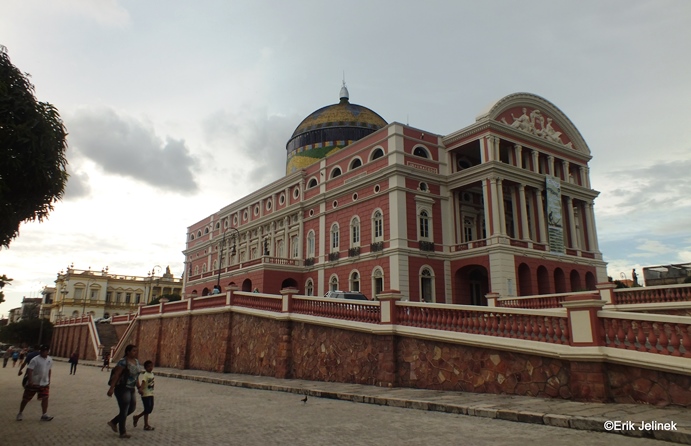
The grandiose Teatro Amazonas, an extravagant masterpiece of European high culture in the middle of the rainforest.


Monday, March 18, 2013

Lost World

The name Roraima may not be familiar to most people, yet nevertheless it is a place that is famous throughout the world. It is one of the largest and tallest of the hundred or so tepui that are found in southeastern Venezuela, spilling over into neighbouring Brazil and Guyana. Tepui are geological formations unique to the area (known as the Guyana Shield): large, sandstone mesas that rise many hundreds of metres, vertically, out of the surrounding countryside. When they were first 'discovered' by European explorers in the mid 19th century they fired the Victorian imagination. The remoteness and inaccessibility of these 'islands' in the jungle, along with the exciting new theory of evolution, led to fevered speculation as to what may live on their summits. The most famous example is Arthur Conan Doyle's book The Lost World where a group of explorers finds a surviving population of dinosaurs (or a more recent incarnation in the animated film Up). When real life explorers finally did make it to the top of some of these tepui they may not have found any dinosaurs, but what they did discover was no less incredible...

Roraima (to the right) and Kukenan (to the left). Still quite a long way to walk to get there.

Sunday, March 10, 2013

The President Is Dead! Long Live The President!

Hugo Chavez was pronounced dead at 4:25pm on Tuesday, the 5th of March. My bus arrived in Caracas at 6pm. I didn't realise until I was on the local bus and heard it on the radio. Although I might have doubted my Spanish skills I couldn't doubt my eyes when I arrived in the city centre and saw it invested with police and national guardsmen at every corner. Every shop was shuttered and there was a sense of an impending storm on the streets. I couldn't find the hostel that I had noted from the internet and was wandering around trying to find somewhere affordable to spend the night without being too conspicuous. Caracas has an unenviable reputation as a dangerous city, and whilst I would scoff at such safety paranoia in Asia my experience of Latin America is not my area of expertise and so I thought it better to play it safe. After a deal of blind wandering I came across an open doorway in a deserted back street with people loitering on the threshold and the word hotel above the door. It looked like a den of ill repute but I was past caring, the rucksack on my back was making me feel uncomfortable and the price was reasonable.

In Venezuela Chavez is everywhere. The cult of personality might not be of Turkmenistani proportions, nevertheless it is hard to get away from him, especially in Caracas. (These posters declaim: "From your hands comes the water of life. We love you!" No false modesty there then.)

Sunday, March 03, 2013

Festival Of Colours

I started my South American by sticking to the Caribbean coast, visiting first Cartagena and then Maracaibo, the major ports of Colombia and Venezuela respectively, though their histories and characters are quite dissimilar. Cartagena was, for over two centuries, the most important Spanish port in the Caribbean, with imposing sea walls and fortresses protecting a sheltered lagoon port (not that that stopped it from being sacked by Francis Drake in 1586). Long regarded as the Pearl of the Caribbean it enjoys its status as doyenne of Spanish colonial culture and is one of the most visited tourist sites in the region. Maracaibo, on the other hand, was long nothing but a provincial backwater. Quite literally as it sits on the shore of Lake Maracaibo, South America's largest lake. It wasn't until the late 19th century, when substantial petroleum deposits were discovered beneath the lake, that the town's fortunes changed overnight, turning Venezuela into one of the world's leading producers of the black stuff. The town has little to recommend itself to passing tourists who rarely stop, except to change buses for somewhere more enticing, where it is not so hot or humid.

Cartagenas old fortifications looking out across to the modern, upmarket Bocagrande neighbourhood.